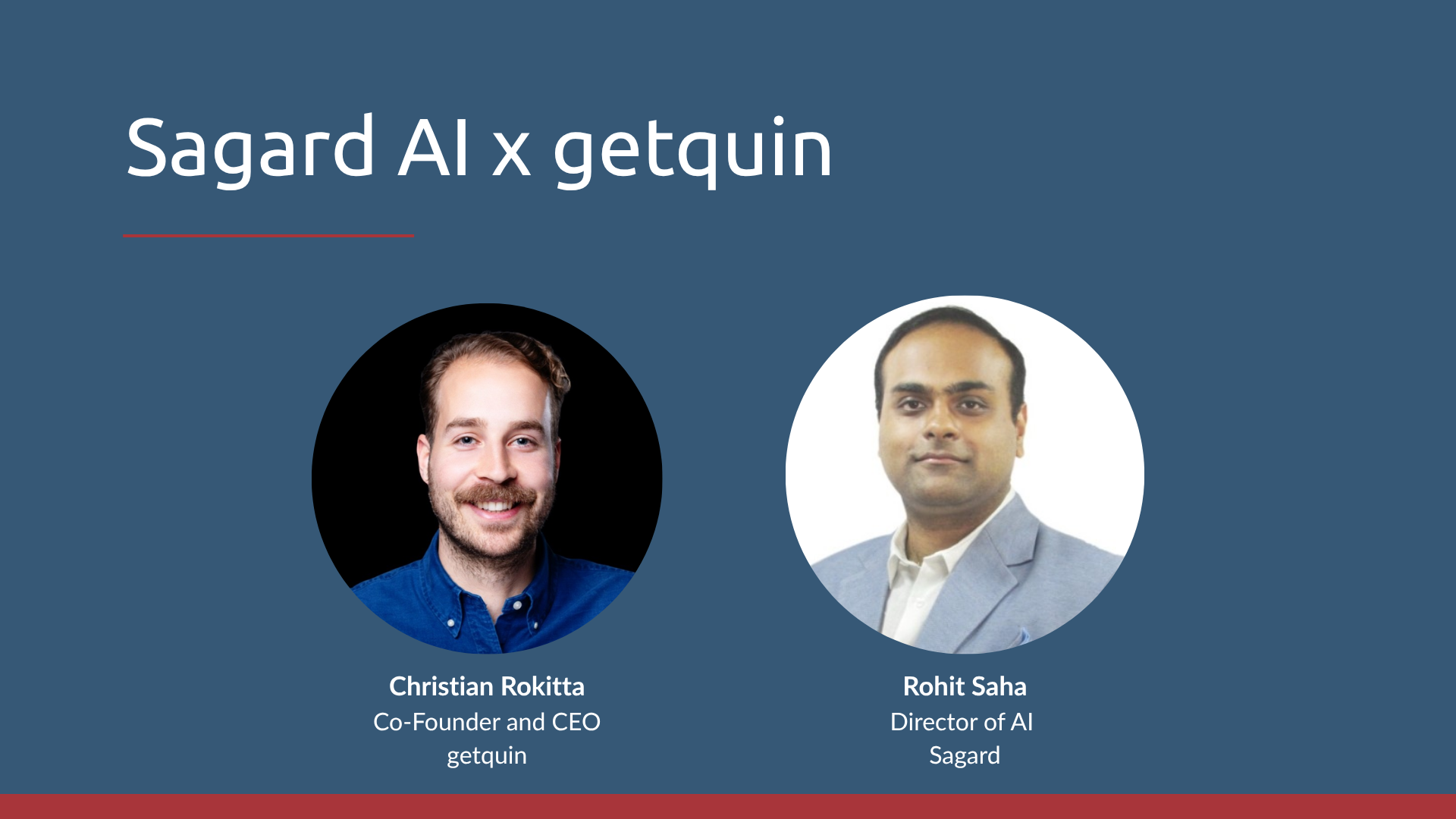
In this edition of the newsletter, we sit down with Christian Rokitta, CEO of getquin, to explore how fintech platforms are beginning to automate financial advice without losing the human element. getquin helps users build a clear view of their financial lives by combining aggregation, planning tools, and AI-powered recommendations. Christian explains why success in financial AI should be measured not by engagement, but by real improvements in outcomes like lower fees, better diversification, and stronger alignment with long-term goals. Ultimately, the discussion shows how AI can augment financial advisors rather than replace them, preserving trust while removing repetitive work.
Complementing the interview, this edition’s AI Corner highlights several notable developments across the AI landscape. GPT-5.4 Pro recently achieved 38% accuracy on FrontierMath Tier-4, a major jump from 2% just a year ago, signaling rapid progress in AI reasoning. Meanwhile, Inception Labs’ Mercury 2 introduces a diffusion-based model for reasoning and code generation that aims to be 10x faster and significantly cheaper than comparable systems, according to the company’s internal tests. We also revisit a dramatic human vs. AI moment where a programmer defeated an OpenAI model in a world coding championship. Finally, we unpack the recent “SaaSpocalypse,” where a set of open-source Claude workflow plugins triggered a $285B selloff in software stocks, raising big questions about the future of SaaS [LINK].
Automating Financial Advice, Without Losing the Human Touch
In this conversation, Christian Rokitta, CEO of getquin, shares how getquin is building a data-driven financial platform designed to give users clarity over their complete financial picture, today and into the future. As a company serving a largely millennial audience focused on long-term goals such as retirement, getquin combines aggregation, planning, and increasingly AI-powered recommendations designed to support users’ financial decision-making. Christian discusses the company’s hybrid AI architecture, how it evaluates success beyond user engagement, and the guardrails required in regulated environments. He also reflects on the future of financial advisors and what responsibility may look like as AI systems grow more capable.
Here are our key takeaways from the interview:
- Outcome Metrics Matter More Than Engagement: In financial services, AI success should be measured by tangible improvements in user outcomes, such as lower fees, better diversification, stronger risk alignment, and progress toward long-term goals. Engagement and satisfaction are secondary to whether the system measurably improves financial well-being.
- Hybrid Architectures Are Essential in Regulated Environments: getquin separates deterministic, compliance-critical workflows from generative AI-powered communication layers. This hybrid approach allows the company to maintain precision and regulatory safeguards where errors are unacceptable, while still capturing efficiency gains in documentation and user interaction.
- Automation Enhances Advisors Rather Than Replacing Them: AI is most effective when it removes repetitive, administrative, and communication-heavy tasks, allowing human advisors to focus on trust-based, high-value conversations. In sensitive domains like finance, a hybrid human-plus-AI model is likely to persist because trust remains a core component of advice.
- Guardrails and Governance Scale With Capability: As AI systems become more advanced, the need for oversight, auditability, and regulatory alignment increases rather than decreases. Responsible adoption requires clearly defined boundaries, human supervision, and compliance structures to ensure that automation enhances efficiency without compromising accountability.
Let’s dive in.
Can you briefly explain what getquin does and where AI fits into the picture?
Christian: getquin helps individuals gain a comprehensive view of their financial lives by aggregating accounts and assets into a single platform for deeper analysis. We’ve evolved from showing simple net worth to offering forward-looking planning tools, helping millennials visualize how they can close potential pension gaps over 10 or 20 years.
AI builds on this data foundation by analyzing structured financial information alongside user-defined goals to generate tailored recommendations. This mirrors the workflow of a traditional advisor, that is, collecting data and providing guidance but does so in a more automated and scalable format to improve user outcomes.
Is your automation powered purely by generative AI, or do you take a hybrid approach?
Christian: We take a hybrid approach and I believe that will remain important, particularly in regulated industries like finance. For compliance-sensitive workflows, such as risk classification, portfolio construction, and suitability assessments, we rely on deterministic systems and classic algorithmic software. In many cases, we intentionally avoid generative AI in these areas because of the need for precision and regulatory guardrails. These are effectively zero-error environments where predictability is critical.
We leverage generative AI primarily for the interaction layer, such as translating complex data into natural language and supporting user Q&A. This helps streamline the heavy communication and documentation workload that usually consumes a human advisor’s time, while keeping core financial logic within structured boundaries.
How do you evaluate LLM performance in a financial advisory context, beyond simple thumbs-up or thumbs-down feedback?
Christian: In my view, evaluation should ultimately tie back to measurable financial outcomes. For example, if one goal is to reduce the total fees users pay, then we should track whether those fees are actually declining over time. If diversification improves, or if risk-return ratios become more aligned with user goals, those are tangible signals. Another important metric is whether users are progressing toward their long-term objectives.
To make this more understandable, we translate financial well-being into a simplified financial health score. That score reflects multiple components, fees, diversification, risk exposure, and goal alignment. Users can see how their score evolves over time and how specific actions influence it. While user satisfaction and engagement matter, they are secondary. The core question should be whether the system contributes to improved financial outcomes in a measurable and transparent way.
As AI systems become more capable, how do you see the role of financial advisors evolving?
Christian: In the short to medium term, I expect a hybrid model. Financial advice is not only about calculations, it is also about trust. Many people prefer knowing there is a human involved, particularly when discussing highly personal topics like wealth, retirement, or family planning. Even if AI systems become highly capable, the trust component may remain important.
A parallel might be healthcare. AI systems may analyze data very effectively, but many individuals still want to speak to a doctor to interpret results and discuss implications. I believe AI will likely make advisors more efficient. Repetitive tasks and administrative processes could become more automated, allowing advisors to focus on higher-value conversations. Some users may eventually prefer fully digital experiences, but for many, a combination of AI-driven efficiency and human oversight could remain attractive.
What is the strongest argument you’ve heard against adopting generative AI in finance, and why hasn’t it convinced you to avoid it altogether?
Christian: The strongest argument is the risk of hallucination or inconsistent outputs in regulated workflows. In certain contexts, such as risk classification or suitability documentation, even a small error can have regulatory implications. That concern is valid.
We explored using LLMs in deeply regulated workflows and encountered challenges with output consistency and reliability. That reinforced the importance of careful prioritization.
However, I don’t believe generative AI needs to replace every regulated process immediately to create value. Financial advisors perform many tasks beyond compliance-sensitive workflows. If AI can improve documentation, reporting, internal efficiency, or customer communication, that is already meaningful progress. Over time, capabilities may improve. But for now, it is about applying the technology where it adds value without introducing unacceptable risk.
If highly advanced AI systems emerge, how should fintech companies think about responsibility and human agency?
Christian: Regardless of technological capability, control and oversight remain essential. Financial services operate within regulatory frameworks designed to protect consumers. Even if AI systems become more sophisticated, they must operate within defined guardrails. Human oversight, compliance processes, and regulatory alignment should remain in place.
It would be risky to allow highly capable systems to independently redefine workflows or decision-making structures without constraints. The responsibility of fintech companies would be to ensure that these systems remain compliant, auditable, and subject to governance structures. Advancement does not remove the need for accountability, it may increase it.
For founders building today, how should they approach company building in an AI-enabled world?
Christian: Founders should remain open and proactive in integrating AI into their operations early. Historically, transformative technologies have enabled new generations of companies to emerge with structural advantages. AI may represent a similar shift. Companies that thoughtfully adopt these tools can operate more efficiently, reduce certain cost structures, and automate workflows that previously required significant manual effort.
That said, especially in regulated industries, founders must balance opportunity with responsibility. Understanding both the advantages and the associated risks is critical. In my opinion, those who thoughtfully integrate AI into core systems, while maintaining appropriate safeguards, may be able to build more capital-efficient and adaptable organizations over time.
We had the time to learn about Christian’s AI-stack preferences,
OpenAI or Anthropic? OpenAI
Claude Code / OpenAI Codex, for coding? Codex
Replit or Cursor? Cursor