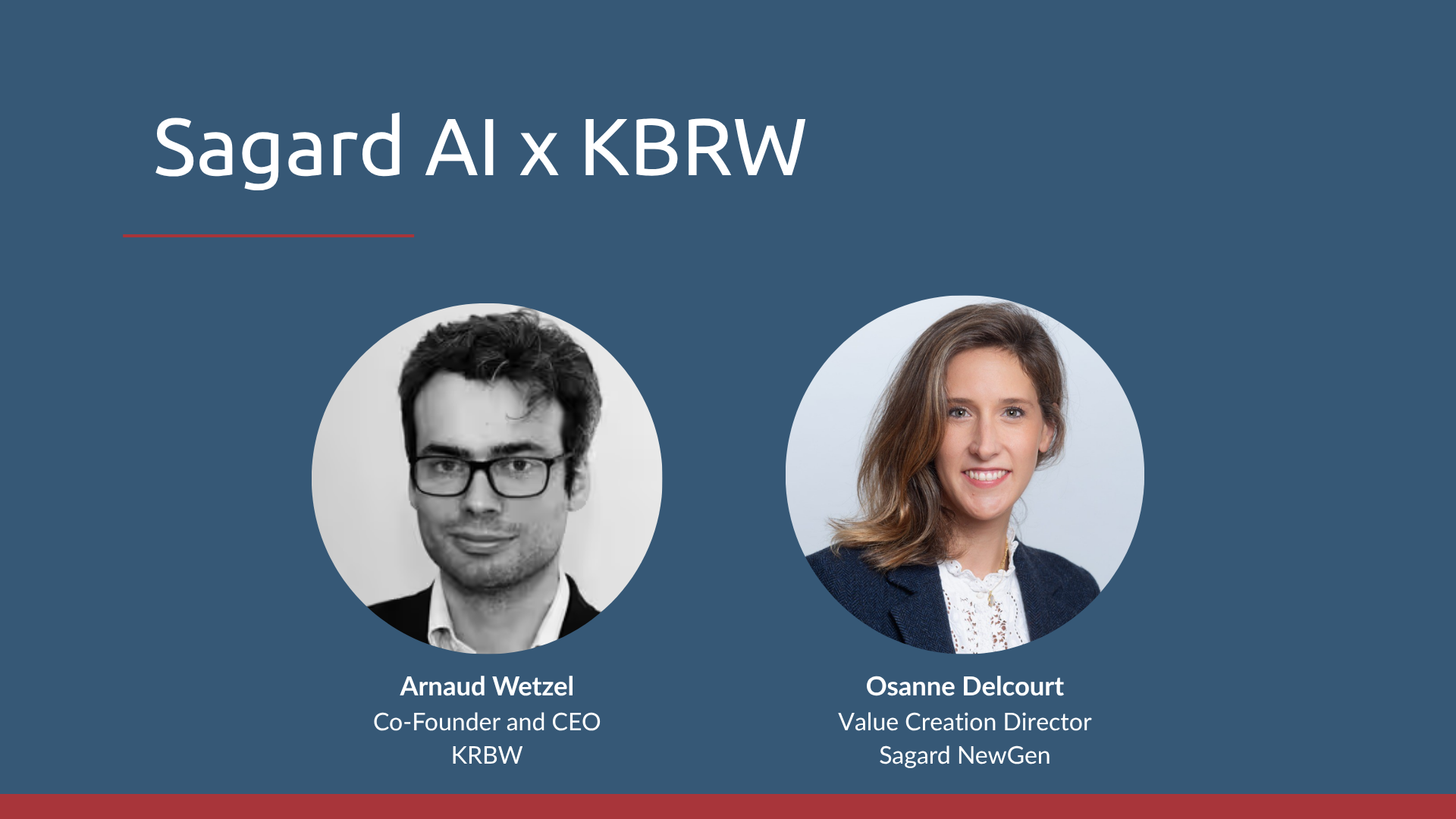
In previous editions of the newsletter, we shared how AI is impacting regulated industries, such as finance, and insurance. In this edition of the newsletter, we took a detour to explore how AI is being leveraged in the supply chain industry. To that point, we sat down with Arnaud Wetzel, CTO of KBRW, a real-time supply chain orchestration platform trusted by some of Europe’s most complex enterprises including Hermès, Michelin, and Carrefour. In addition to sharing his vision of supply chain’s future and the role of AI in it, Arnaud also offers a candid take on AI in engineering, from why brownfield codebases may actually be better suited for AI than greenfield projects, to why most teams are tracking the wrong metrics entirely. Towards the end of our interview, we had just enough time for a rapid fire round!
Complementing Arnaud’s story, our AI Corner this edition covers five developments reshaping the physical and digital supply chain: Locus Robotics’ new Robots-to-Goods fulfillment category, NVIDIA’s first scaling law for robot dexterity, the KION and Siemens digital twin stack unveiled at GTC 2026, Anthropic’s Claude Mythos and its implications for supply chain cybersecurity, and Microsoft’s aggressive push to deploy 100 AI agents across its own supply chain by year-end.
Building the Intelligent Supply Chain: Inside KBRW’s AI Strategy
Arnaud Wetzel has served as CTO of KBRW for 16 years, building the company into a mission-critical orchestration layer for some of Europe’s most complex supply chains. In this conversation, Arnaud argues that AI won’t simply reduce the number of supply chain planners. Instead, it may actually expand the role, shifting teams away from operational busywork and toward the kind of strategic complexity that was previously too difficult to even attempt. He also shares what engineering leaders consistently underestimate about AI’s value in software development, and offers a practical framework for measuring AI-driven engineering productivity without losing sight of technical debt. The discussion is grounded in KBRW’s direct experience running real-time decision systems for CAC 40 companies including LVMH, Michelin, and Carrefour.
Here are our key takeaways from the interview:
- Execution is a critical competitive differentiator: For years, enterprises invested heavily in planning systems. Arnaud’s view is that in a world of constant disruption, how fast you can act on a plan matters a lot, and that shift has profound implications for where software value sits.
- AI reclassifies exceptions, it doesn’t eliminate them: A surprising amount of what supply chain teams treat as unpredictable chaos is actually recurring patterns that nobody had the bandwidth to codify. AI may finally close that gap, freeing human judgment for the disruptions that genuinely can’t be anticipated.
- Don’t measure AI by how fast engineers type: The coding speed gains are real but, in Arnaud’s view, they’re not where the story ends. The deeper wins are in making complex systems understandable to more people and raising the quality floor across an entire engineering organization.
- AI creates a new kind of technical debt and most teams aren’t tracking it: The debt that accumulates through AI-generated code, documentation, and tooling looks very different from traditional debt. Arnaud offers a practical three-category framework that any CTO could start applying today.
Let’s dive in.
To start, could you introduce yourself and give us a sense of what KBRW does?
Arnaud: I’m the CTO of KBRW, a role I’ve held for 16 years. The problem we solve is one that large enterprises in luxury, automotive, and retail increasingly face: their supply chains have become technically unmanageable. Years of M&A have left behind complex webs of ERPs, planning systems, and legacy infrastructure, while customer expectations have shifted toward real-time availability, dynamic lead times, and personalized offers. ERPs were built for conformity and long-horizon planning, not real-time orchestration, and in the current geopolitical climate, plans rarely hold for long anyway.
That’s where KBRW comes in. We provide a real-time execution and decision layer that decouples execution from ERP and planning systems, sitting as an orchestration layer on top. We handle orders, inventory, and operational decisions at high transactional throughput across multiple channels, brands, and geographies. Today, CAC 40 companies including Hermès, Michelin, and Carrefour run on our systems.
Supply chain is a domain where the most critical problems live at the edges. From your perspective, where could AI most fundamentally enhance the overall offering — on the execution side or the decision-making side?
Arnaud: I don’t think it’s an opposition. The most important shift is what AI does to exceptions. A large proportion of what we call exceptions in supply chain are actually predictable patterns: late deliveries from a specific supplier, seasonal spikes that repeatedly catch the same warehouse off guard. The problem historically has been that no team has had the bandwidth to codify and analyze all of them. AI could change that, absorbing those patterns autonomously and reclassifying them as manageable events rather than crises.
What remains as a true exception are geopolitical disruptions and major unexpected shocks. For those, AI doesn’t eliminate the challenge, but it may compress the response time significantly. When a disruption hits, the question becomes: how quickly can you assess the impact, generate alternatives, and execute a decision? AI could make that loop considerably faster.
As AI becomes more context-aware about supply chain dynamics, do you foresee fewer planners in the future, or more?
Arnaud: The honest answer is you’ll likely need fewer people doing today’s operational planning work, but potentially more in different, more strategic roles. Without AI, many companies don’t even attempt to manage truly complex patterns because the complexity is simply too great. When AI makes that manageable, it may actually create demand for more supply chain professionals, but ones focused on setting parameters, overseeing AI-driven decisions, and working at a higher level of abstraction.
Simple operational planning work likely won’t be handled by humans in the same way. But overall performance could improve considerably as a result.
When you talk to your customers about AI capabilities, does the excitement translate into faster deals, or do challenges still surface?
Arnaud: The biggest challenge is fear, and it tends to come from two directions. The first is the fear of making a major software commitment during a period of rapid change. When you’re building critical software, you’re thinking on a 10-to-20-year horizon, and right now nobody knows what the SaaS ecosystem or typical IT architecture will look like in two or three years. The second fear is around autonomous decision-making. Governance frameworks, conformity models, and safety nets need to be in place before you can hand decisions to AI at scale, and many enterprises simply aren’t there architecturally yet.
Sitting between both fears is a third: the fear of inaction. Companies that do nothing risk falling meaningfully behind their competitors. It’s a genuine paradox, and most of our customers are navigating all three simultaneously.
Where do you think the supply chain industry is still underestimating AI’s potential for disruption?
Arnaud: The future role of the planning layer is one area I think deserves more honest conversation. The boundary between planning and execution could blur considerably as AI-driven decision-making gets embedded deeper into execution systems. When that happens, execution layers start handling things that traditionally lived in the planning cycle, like real-time inventory reallocation, dynamic lead time promises, and proactive flow rerouting. That shift in where value sits is something most people in the industry aren’t fully reckoning with yet.
To be clear, planning doesn’t disappear. Planning systems are built for asynchronous, large-scale analysis; real-time execution layers are built for high-throughput decisions under live customer demand. These are fundamentally different architectures, and that gap doesn’t disappear just because AI makes software faster to build. Production experience at scale also compounds: the fact that we orchestrate real-time decisions for companies like Louis Vuitton across global stores and e-commerce means adding autonomous capabilities is a natural extension of what we already do.
Shifting to engineering – after all the exploration you and your team have done with AI tools, where do you see genuine value in the SDLC, and where is it mostly hype?
Arnaud: This may surprise you, but I think there isn’t enough hype in certain areas, and the most important one isn’t code generation. Code generation is real and meaningfully faster, but it’s not the most transformative part. Where AI has been most valuable for us is in making complexity manageable. We build supply chain systems where the business domain, architecture, and codebase are all deeply intertwined and genuinely complex. That knowledge historically lived in senior engineers’ heads and took months to acquire; AI workflows make it readable, so any engineer can now interact with the full context of business rules and architectural decisions.
The second underrated area is standards and consistency. As a mid-sized company, it’s difficult to apply security and industry best practices systematically across all engineering scopes. AI now allows us to encode and apply those standards at any level, without needing to be a large, mature organization to do so. The real gains are upstream, in how engineers understand what they’re building and the consistency with which they build it.
Is AI actually easier to apply in brownfield environments with massive existing codebases, or in greenfield projects starting from scratch?
Arnaud: Counterintuitively, brownfield is often more tractable. A blank-slate project seems easier at first, but the technical debt risk is much higher because you’re producing large volumes of code without the structure to manage it responsibly. With an existing system, you can document it progressively, make it readable, and build on it in a controlled way.
If you think in terms of net value, meaning value created minus technical debt incurred, it tends to be higher in complex existing systems than in new greenfield projects built primarily with AI-generated code. The discipline that a mature codebase forces on you is actually a feature when working with AI, not a limitation.
What separates engineers who get the most out of AI from those who don’t?
Arnaud: The biggest differentiator is whether an engineer sees AI as a thinking partner or simply as a typing assistant. Many tools are called copilots, and that framing shapes how people use them as a helper for getting through tasks faster. That’s a limited mental model. The best engineers think differently: they ask what system of assets and thinking partners they can build to create the outcome they want. They’re focused on outcomes, not tasks, and that requires a certain seniority of perspective.
The average engineer prompts immediately with minimal context, gets something back, and then spends significant time fixing and maintaining it. The best engineers invest their own deep reasoning upfront, in how they frame the problem and structure the system, and use AI to amplify that reasoning rather than shortcut it.
What metrics should CTOs track to understand whether AI is genuinely improving their engineering function?
Arnaud: Keep your existing DORA metrics, but couple them with AI workflow tracking at each stage of the build process so you can compare AI-assisted work to human work meaningfully. What changes is how you need to think about technical debt, because the debt profile with AI is fundamentally different. I’d suggest tracking it across three categories: production code, where AI generates the most visible output but also the highest debt risk since more code in production means more to maintain and a larger security surface area; cognitive and organizational assets like documentation and specifications, where AI can easily generate volume that becomes a liability if left unmanaged; and decoupled service code like test suites and simulators, where debt risk is low and you can focus almost purely on performance.
For tooling, integrate AI-specific tagging into your existing CICD infrastructure, Jira, GitHub, and the like, rather than adopting separate external platforms. The best metrics are the ones already native to your organization’s workflow.
Are there specific tools you’d recommend for tracking these metrics, or do teams need to build in-house?
Arnaud: There may be vendors out there doing this well, but we haven’t found one that fits yet, so we’ve built our own. The core principle is that the best metrics are the ones already native to your organization, not ones designed specifically around AI. Integrate AI tagging and signals into your existing CICD tools rather than layering on external platforms. Start with what you already use and extend it thoughtfully.
We had the time for a few rapid fire questions.
Claude Code or OpenAI Codex?
Arnaud: Claude Code.
Anthropic or OpenAI — which would you bet on?
Arnaud: Anthropic. Though not with complete certainty.
Best coding tool overall?
Arnaud: Claude Code, paired with custom in-house tooling. We deliberately avoid large IDE integrations and prefer building lightweight workflows around it ourselves.
Google or OpenAI for consumer-level search?
Arnaud: Google for now. Though for professional use, ChatGPT currently has the edge.
Will open source take significant share from the major LLM providers?
Arnaud: Open source could come to dominate, but it will likely be dominated by the same companies currently leading the proprietary space. The landscape becomes more open, but the key players may well remain the same.