Locus Robotics launches Locus Array, defining a new category: Robots-to-Goods. On April 13 at MODEX in Atlanta, Locus Robotics launched Locus Array, a fully autonomous fulfillment system combining mobile robotics, an integrated picking arm, and AI-powered perception. The interesting part isn’t the hardware; it’s the new category. For a decade, warehouse automation has been dominated by Goods-to-Person (the model Amazon’s Kiva robots pioneered, where racks travel to stationary pickers). Locus is flipping it: the robots travel, the racks don’t have to. With 6 billion robot-assisted picks logged, 17,000 AMRs across 350+ facilities, and DHL Supply Chain already an early access customer, Locus is betting R2G is the next decade of fulfillment.
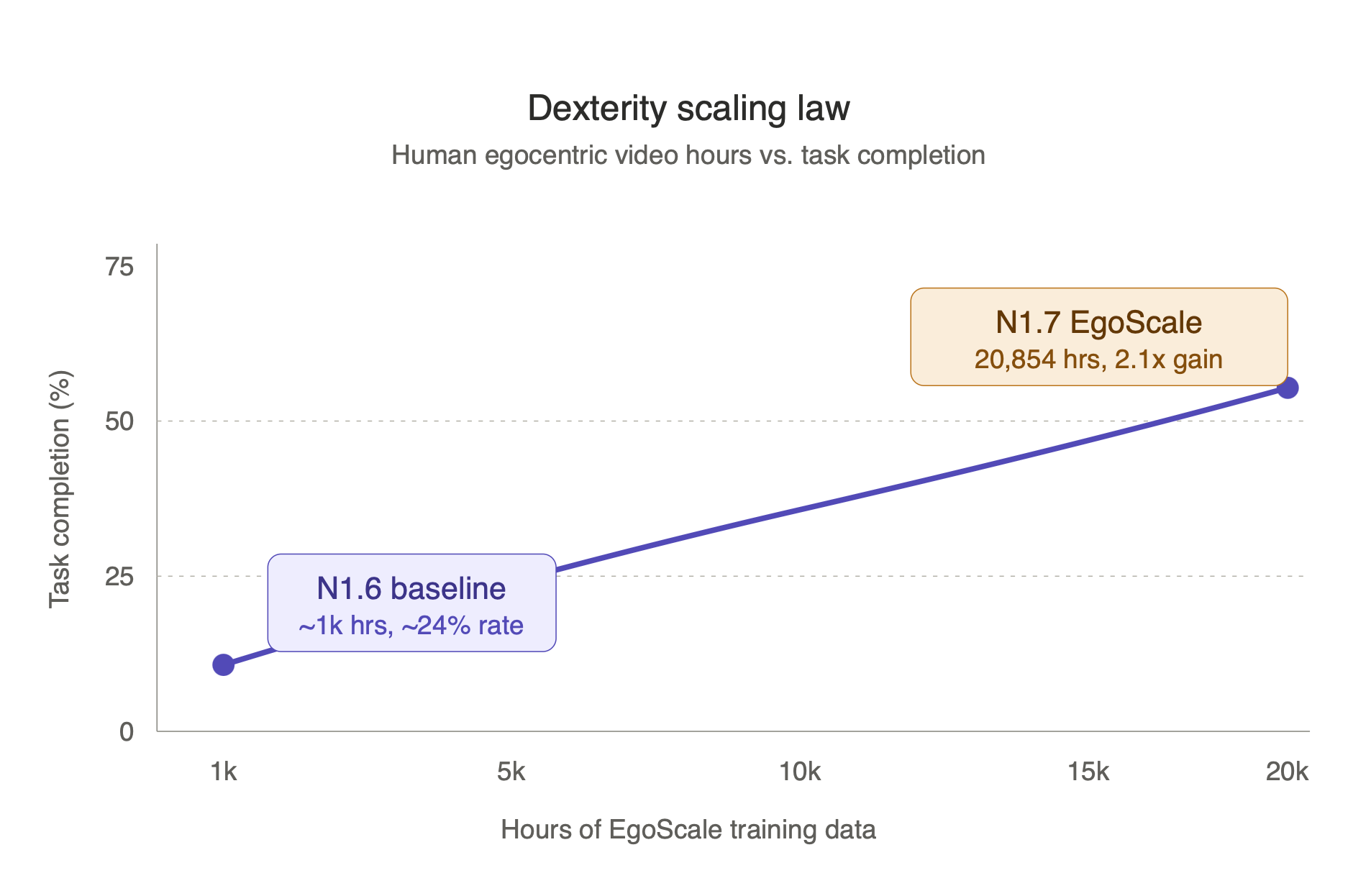
NVIDIA discovered the first-ever scaling law for robot dexterity. Isaac GR00T N1.7 launched in March under Apache 2.0 with partners across AGIBOT, Humanoid, LG, NEURA, and Noble Machines – but the license wasn’t the real story. GR00T N1.7 was pretrained on 20,854 hours of human egocentric video, 20x the prior version, across 20+ task categories. Humans and robots share embodiments (two hands, first-person view, objects to manipulate), so sensorized human video delivers manipulation priors without per-behavior teleop. Scaling from 1k to 20k hours more than doubles task completion. For warehouse pick-and-place: no bespoke data per SKU – EgoScale generalizes [GitHub].
The whole warehouse, born in simulation. At NVIDIA GTC 2026, the KION × Siemens × Accenture × NVIDIA × GXO stack got its full unveiling – arguably the most complete articulation of physical AI in logistics yet. KION builds physics-accurate digital twins in NVIDIA Omniverse to train fleets of Jetson-based autonomous forklifts for GXO, the world’s largest pure-play contract logistics provider. The stack: GR00T N1.7 for perception, Isaac Sim 6.0 + Isaac Lab 3.0 (with the new Newton 1.0 physics engine) for simulation, Omniverse + Siemens Digital Twin Composer for the twin, Jetson Thor/Orin onboard. NVIDIA’s Rev Lebaredian: “Factories themselves are now robotic systems. All factories are born in simulation.”
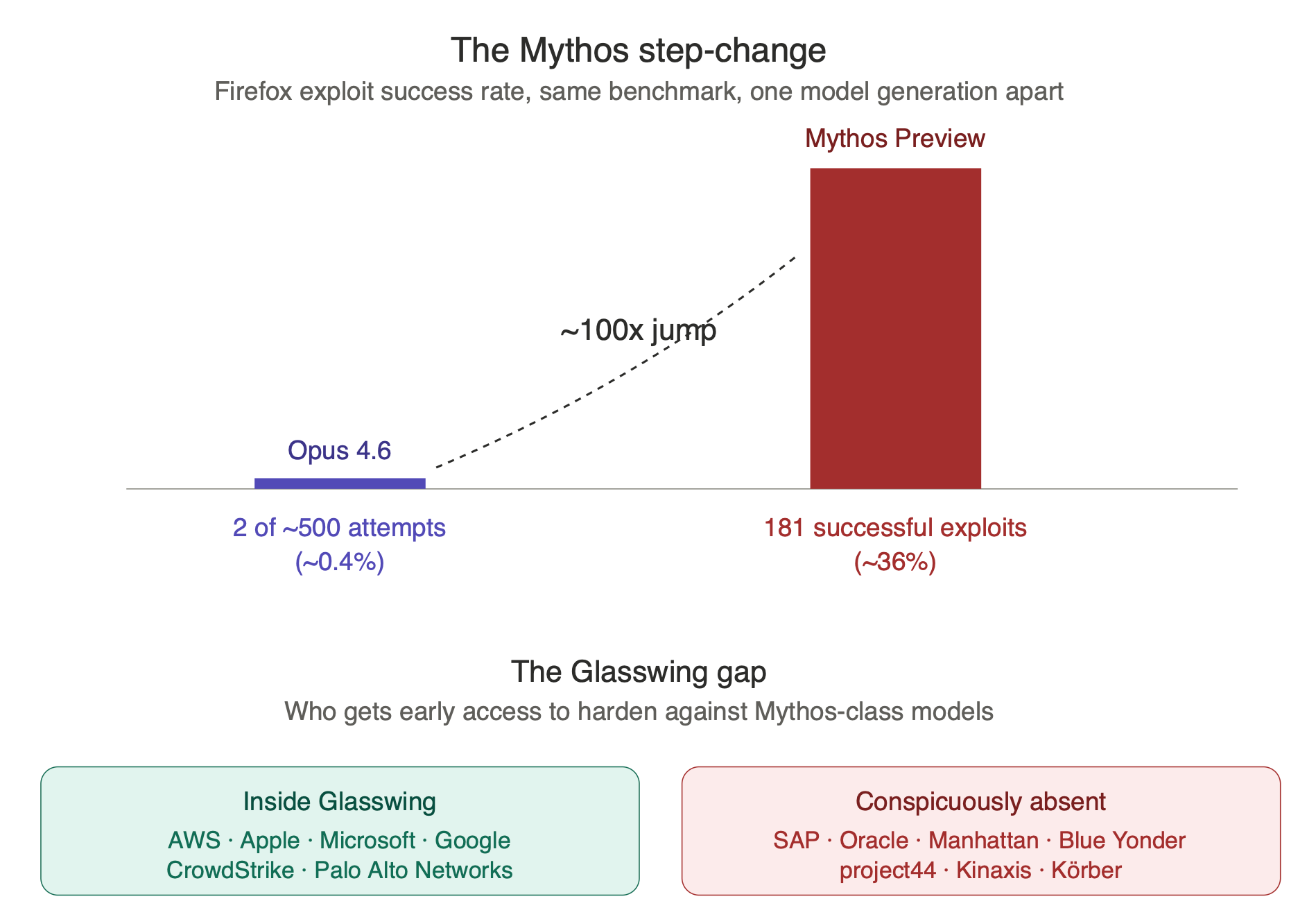
Claude Mythos just made every legacy SCM codebase a target. On April 7, Anthropic announced Claude Mythos Preview – a model that can identify and exploit zero-day vulnerabilities in every major OS and web browser when directed. The jump is staggering: Opus 4.6 turned its discovered Firefox vulnerabilities into working exploits only 2 times out of several hundred attempts. Mythos did it 181 times — roughly 100x in a single model cycle. Over 99% of the vulnerabilities found remain unpatched. Anthropic restricted the release via Project Glasswing (AWS, Apple, Microsoft, Google, CrowdStrike, Palo Alto Networks), but notably absent are any enterprise SCM vendors. In a software-mediated supply chain, cyber weakness increasingly becomes operational weakness: a compromised TMS is a logistics problem, a weak WMS is a fulfillment problem.
Microsoft wants 100 agents running its own supply chain by year-end. At Hannover Messe in April, Microsoft revealed internal targets more aggressive than most customers realize: 100+ agents operating by the end of 2026, with agentic support for every employee. AI in logistics is already saving Microsoft teams hundreds of hours monthly. The architecture, unveiled with Capgemini, layers Work IQ, Foundry IQ, and Fabric IQ stitched together with Celonis Process Intelligence Graph. One pharma customer uses the stack to flag temperature-critical returns in real time, unlocking multi-million euro annual gains. Agent 365, the control plane for monitoring agents, goes GA in May 2026. Every vendor is racing to build the same thing, but Microsoft has the distribution (Teams, Dynamics, Copilot) and enterprise data plumbing nobody else can match.