PERE
By Randy Plavajka
Private real estate credit managers seeking to diversify their investments in alternative sectors are primed for more in the industrial sub-category.
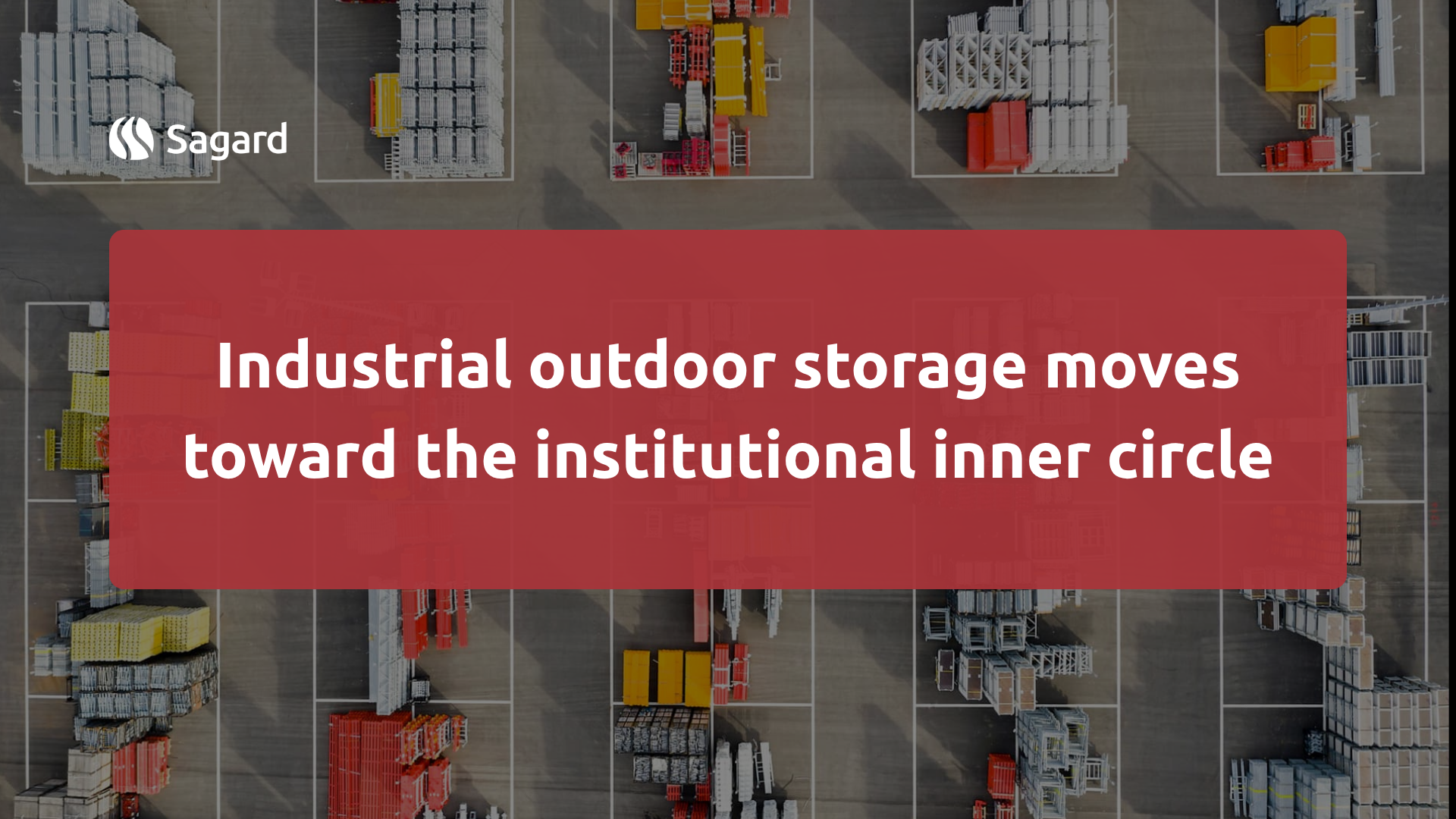
The industrial outdoor storage sector, an oft misunderstood and even more often abbreviated category known as IOS, is undergoing an institutional metamorphosis.
The sector has spent most of its existence as a “handshake asset class,” with local operators leasing sites informally, and no institutional debt product built around pricing the risk, according to Vinh Thai, senior vice-president, investments, at Zenith IOS.
Five years ago, when New York-based Zenith IOS opened its doors as a specialist asset class as part of a joint venture with JPMorgan Asset Management, the landscape was different.
“There was no institutional debt. No one knew how to price it. There are no credit vehicles for this. Definitely, CMBS would not touch this asset class,” Thai said.
Today, the baseline has shifted. A wider range of platforms are now running secured debt books with significant lending allocations toward IOS. Zenith, as one entity in the space, has secured roughly $400 million in financings since its inception and has been going to the market throughout 2026 to layer in another $200 million to support its national portfolio.
Alterra IOS, another specialist contemporary in the IOS sector, has surpassed $2 billion in borrowings across nearly 500 properties in 39 states.
Realterm, a Maryland-based manager, is working the IOS space from an ownership and a lending seat, building out a dedicated credit business to serve the mid-market gap other lenders may not want to underwrite.
The pattern across all three has been made apparent: private credit is getting its slice of IOS while bank lenders still look to find concrete footing.
Jesse Harty, head of CBRE Investment Management’s Americas logistics operator division, tells PERE that most traditional industrial owners have always carried a degree of IOS acreage alongside their core portfolios. But the shift toward dedicated IOS-only ownership has picked up speed within the past decade as aggregators – including Industrial Outdoor Ventures, Alterra, Zenith and Triten – started to buy individual properties from local operators for $1 million-$5 million apiece before building enough scale to attract institutional partners.
The second wave of IOS institutionalization is well underway, Harty says, citing distinct fund efforts including TPG Angelo Gordon, JPMAM, Catalyst Investment Partners and various pension funds as reflected in PERE data that have raised roughly $3 billion recently for IOS investment. Zenith’s own venture with JPMorgan alone exceeds $1.5 billion in gross asset value.
Open lane
Thai said bulge-bracket commercial banks remain largely on the sidelines. “They’re not going to come into the [fray] until several more years down the line,” he tells PERE.
One market participant tells PERE they have former banking colleagues at such institutions who still call to ask about the IOS market without ever committing capital to it.
Private real estate credit lenders are filling the financing void instead. One market source estimates private real estate credit now represents 50-60 percent of IOS lending activity. Blackstone has represented one such example. Since 2025, the New York-based manager has committed $469 million of debt financing to Alterra IOS Venture III across two separate financings, including a February 2025 deal that was upsized to $225 million post-closing and a May 2026 financing totaling $244 million.
Blackstone’s activity includes funding a roughly $150 million facility with Alterra as part of its own expansion deeper into the alternative industrial sub-category.
Harty says a similar dynamic is playing out in the capital markets. “Debt has followed equity flows into IOS as lenders have more conviction in the space,” he says, noting that the yield premium IOS still commands over core industrial is narrowing as more capital arrives.
As shown in Q1 data this year from Clarion Partners and CBRE Econometric Advisors, IOS has historically priced at a 50- to 100-basis-point cap rate premium to traditional warehouse product.
CBRE data also shows net-lease investment volume, which ranks as the dominant deal classification for IOS, surged 57 percent year-on-year in Q4 2024 with industrial and logistics product growing its share of overall net-lease activity to 64 percent.
Underwriting scarcity
Private real estate credit’s IOS story parallels a supply and demand imbalance outlined in nearly identical terms by every market participant PERE has spoken with in recent quarters. At any given time, vacancy across IOS nationally hovers near 3 percent, clocking in at about half the rate of traditional industrial product, Thai estimated based on third party data sources. In the past five years, IOS rents have also climbed an estimated 130 percent.
Nathan Kane, head of research at Realterm, says that scarcity can be linked to zoning rather than capital constraints.
“We’ve been investing in this property type for 35 years, and it is fun to watch it become institutionalized now,” Kane says. He notes that US municipalities have little incentive to preserve IOS zoning, given the lower tax base and limited job creation the use case generates relative to other commercial developments.
The scarcity in turn shapes how lenders go about underwriting their entries and expansion efforts in the space. As with most stateside asset classes, there is variance from region to region and state to state.
CBRE’s Q4 2025 research places the IOS national rent premium at 17.9 percent compared with traditional industrial, up slightly from the same period in 2024. IOS net rents at 2025’s end averaged $13.14 per square foot against $10.85 for standard industrial, and IOS vacancy clocked at 2.5 percent, as opposed to the broader sector’s 6.7 percent. The Midwest US commands the widest spread at 28 percent, followed by the West at 25 percent, the South at 24 percent and Northeast at 16 percent, with the pattern backed by major US logistics hub trends.
Kansas City topped CBRE’s list of individual metropolitan areas at a 58.5 percent premium; followed by Sacramento, California, at 52.8 percent; Savannah, Georgia at 49.1 percent; Oakland, California, at 49 percent; and Chicago at 48.1 percent.
Paul Sisson, who leads the credit platform at Realterm, says the market for sub-$150 million loans remains underserved because granular, multi-parcel IOS portfolios are difficult to evaluate at scale. He considers the gap to be an opportunity.
“[Hypothetically], you could have a $50 million loan that is basically 24 properties, so you have the due diligence of a typical large loan portfolio with a mid-market loan,” Sisson says. He adds that contemporary private real estate credit managers lacking a dedicated underwriting and acquisition team targeted toward IOS tend to pass on the complexity of such opportunities entirely.
Mark Bigarel, president of Denver-based manager Sagard Real Estate, says there is a parallel gap on the equity side, where his firm pursued what it once called “covered land” plays long before the IOS label existed.
“It’s not that complicated, but it’s hard to do,” Bigarel says about sourcing infill sites. He notes that the IOS market has a significant degree of opacity, which can keep larger institutional capital out. Such has been the case until recently.
Bigarel says private lenders arrived first in the IOS sector because of the chase for yield. Upon deeming the risk worthwhile and underwriting it correctly, these alternative sources of capital were able to land a foot in the door while bank lenders needed more convincing to get comfortable, especially factoring in vacant or transitional sites.
Land-driven underwriting, as opposed to building-driven, has been a key point of differentiation for pursuing IOS deals, as market participants tell PERE. This model shifts underwriting toward per-acre land pricing as opposed to per-square-foot metrics and leases then are generally structured as triple-net. “One of the biggest challenges to underwriting IOS has been the limited comps and data opacity,” Harty says, noting the major brokerages do not cover IOS the way they cover traditional industrial, so pricing depends heavily on an operator’s proprietary data.
Deal sizes can compound the problem too, Harty says. With individual transactions running at around $10 million, institutional capital pushes toward aggregating in lieu of one-off deployments for single assets.
Zoning as collateral
Market participants tell PERE that zoning has been a primary mechanism driving the viability of financing IOS at all.
Bigarel says zoning is the deciding factor in whether his team even evaluates a site, often preferring locations with the broadest possible range of permitted uses so demand does not hinge on a single tenant category.
Matt Pfeiffer, managing partner and chief investment officer at Alterra Property Group, has observed the trend too. “If you have a property that allows for multiple uses, in my view, that is Class A zoning,” he said. Pfeiffer noted Alterra’s underwriting prioritizes proximity to highway infrastructure, ports and intermodal facilities, paired with the widest possible zoning envelope across IOS uses.
The bidding process for competing loans is reflecting sponsor-side demand for premier space.
Pfeiffer says Alterra has moved from fielding two or three term sheets about five years ago to more than 10 per deal today, spanning banks, debt funds and increasingly, insurance companies. The platform’s average financing facility size now exceeds $100 million, structured against pools of assets rather than single properties.
Zooming in on Alterra IOS Venture III specifically, the firm’s average individual loan facility for the vehicle includes 45 properties.
Alterra closed a $244 million financing from Blackstone in May this year and a $400 million financing with Truist and Key Bank in July this year on a pledge of equity basis, as opposed to traditional mortgages.
The Alterra IOS Venture III strategy, which PERE data shows held its final close in April 2024 with $925 million of committed capital, surpassed its target raise of $750 million during a 14-month roadshow. The largest three known commitments on the vehicle’s roster include $100 million from the Teacher Retirement System of Texas; $100 million from New Mexico State Investment Council and $78 million from the State Board of Administration of Florida. Both TRS Texas and SBA Florida have consistently held rank on PERE‘s Global Investor 150 (previously 100), including this year’s iteration.
IOS aggregation efforts have allowed Alterra and similar IOS asset managers to have flexibility in leasing traditional sites before shifting them into a more stabilized financing pool. Pfeiffer says the CMBS market remains the one segment of the market that has yet to engage with IOS on a repeat basis, although IOS had appeared as a portion of many recent CMBS financings. Realterm’s Sisson and Zenith’s Thai both echo the securitized market’s absence.
Where zoning can be a boon, tenant credit is a distinct bane, cutting against the bullish grain among IOS sector specialists.
Kane notes IOS tenants – which include trucking and logistics operators – are often poorly capitalized and prone to bankruptcy. “The credit quality in the transportation sector is not very good,” he says. “But the actual credit loss in the space is very, very low.” Kane says when an IOS tenant fails, competing freight operators typically absorb the site and its underlying demand almost immediately.
Sisson says Realterm’s lending approach has been built around underwriting through to that replacement demand rather than to any single tenant’s balance sheet. This distinction separates the IOS sector from how broader industrial sector lenders may chase large, single credit tenant transactions.
Rolling onward
For the IOS sector’s outlook, the four executives noted the market is not at risk of overheating, though Sisson cited a broader concern about private credit inflows generally.
Sisson cautioned against lenders getting ahead of themselves on pricing before the sector has had time to season. Thai and Pfeiffer both pointed toward continued acquisition and refinancing activity as being the primary realm for fresh debt capital, because of how difficult IOS remains to entitle and build from scratch.
Bigarel, whose firm joined forces with a capital allocator to build an IOS portfolio over several recent years, says the strategy all depends on treating aggregation as the source of value rather than as a bridge to a quick sale.
Harty says he expects growth in the sector to come from a combination of acquisition and refinancing activity, a continuing trend reflected in data from PERE‘s Lending Barometer. From January 2025 onward, barometer data has tracked 15 loans totaling $1.68 billion originated by private real estate credit lenders. Across that total, a combined 80 percent of financing deals were for refinancing or acquisition purposes.
Secular drivers for IOS absorption ahead, as noted in CBRE’s research, include federal and congressional-backed infrastructure spending, utility and power grid modernization and rising domestic manufacturing. Newmark data estimates the readily tradable IOS universe at around $200 billion. For private credit lenders, that scale creates gaps ahead for private debt to fill.
The IOS institutionalization sequence carries shades of the same pathway taken by the self-storage sector a decade earlier: a fragmented asset class where the debt market lags the equity story until enough repeat transactions accumulate to give lenders a data set they can trust to underwrite.
IOS has found itself in the middle of that sequence in today’s market, and market participants expect private real estate credit to continue to perform the heavy lifting, while banks and insurance capital figure out when and how they want to underwrite the rest of the opportunities to come.