What’s in this article
- How do sponsored and non-sponsored credit compare?
- What is the sponsored credit market?
- What is the non-sponsored credit market?
- How can maintenance covenants support early intervention?
- Closing thought
The sponsored and non-sponsored credit markets represent two distinct segments within private credit and the broader leveraged finance landscape. The key differentiator between them is whether the borrowing company is backed by a private equity (PE) sponsor. While the sponsored market accounts for the majority of overall private credit transaction volume, the non-sponsored segment represents a meaningful and differentiated opportunity set within the asset class.
How do sponsored and non-sponsored credit compare?
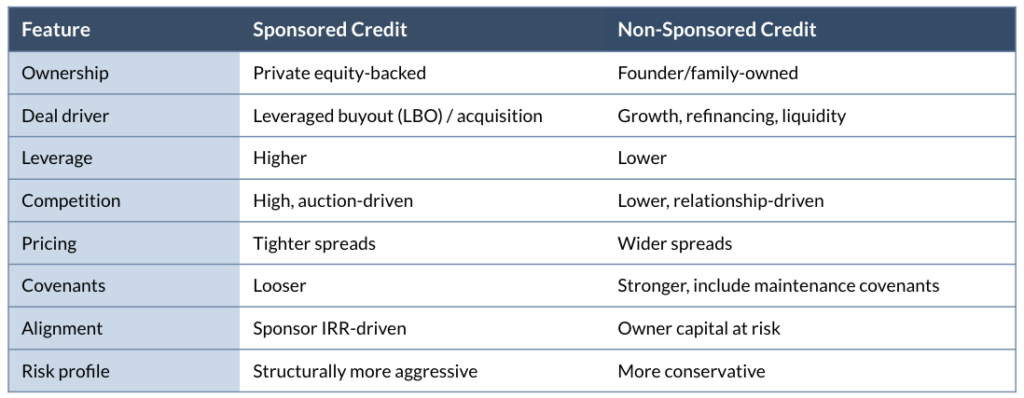
Before exploring each segment in detail, sponsored and non-sponsored credit typically differ across key dimensions:
What is the sponsored credit market?
The sponsored credit market consists of loans made to companies owned or controlled by a private equity sponsor. In these transactions, the financial sponsor plays a central role in shaping the company’s strategy, governance, and capital structure. Lenders therefore underwrite not only the business itself, but also the strength, track record, and reputation of the sponsor.
A typical sponsored transaction begins with a leveraged buyout (LBO), in which a private equity firm acquires a company using a significant amount of debt financing. That debt may be provided by private credit funds, business development companies (BDCs), or the broadly syndicated loan market. The underwriting process considers both the company’s fundamentals and the sponsor’s capital commitment, operational capabilities, and value-creation plan.
The sponsored segment benefits from high deal flow and institutional processes. Sponsors may bring operational expertise, M&A experience, and structured governance frameworks. They often implement professional reporting systems and strategic oversight, which can enhance transparency and operational discipline. In addition, meaningful equity capital beneath the debt can provide a financial cushion.
However, these strengths must be viewed in the context of market dynamics. Sponsored transactions are typically highly competitive, often resulting in tighter pricing and more borrower-friendly terms. They also tend to involve higher leverage and more complex capital structures, reflecting the LBO model. Because financial sponsors seek to optimize internal rates of return (IRR), capital structures may include dividend recapitalizations or other strategies that increase financial risk over time. As a result, despite strong governance, the overall credit profile may be more aggressive due to leverage levels and structural complexity.
What is the non-sponsored credit market?
The non-sponsored credit market includes loans made to companies that are founder-owned, family-owned, or entrepreneur-led, without private equity ownership. In these transactions, lenders focus directly on the company’s management team, cash flow profile, and long-term business fundamentals.
Non-sponsored borrowers typically seek financing for organic growth, acquisitions, shareholder liquidity, or refinancing. Unlike LBO-driven transactions, these situations are generally not purchase-price driven and therefore tend to carry more conservative leverage levels. Without the pressure of acquisition premiums, capital structures are often simpler and more sustainable.
Importantly, the non-sponsored market is less intermediated and less auction-driven. Transactions are frequently relationship-based, allowing lenders to take a more tailored and solutions-oriented approach. This dynamic can result in wider spreads, stronger documentation, and tighter covenant packages, including maintenance covenants, compared to highly competitive sponsored deals.
Alignment is often a distinguishing feature. Founder- and family-owned businesses typically have significant personal capital invested in the company and may prioritize long-term stability over short-term financial optimization. This alignment can translate into prudent decision-making, conservative leverage, and a focus on sustainable growth.
From a risk-adjusted return perspective, the non-sponsored market can be particularly compelling. Lower competitive intensity may allow lenders to earn higher spreads on companies with stronger credit metrics than those found in sponsor-backed LBO transactions. In other words, lenders may be compensated more attractively for fundamentally lower leverage risk.
Additionally, robust maintenance covenants provide an early-warning mechanism that enhances downside protection. If a borrower approaches or breaches a covenant, often well before experiencing true financial distress, lenders have the opportunity to engage proactively. This can lead to repricing, additional equity support, amended terms, or improved structural protections, creating incremental return opportunities while risk remains manageable.
How can maintenance covenants support early intervention?
Illustrative Example: Covenant breach with early intervention and lender control
Structure at origination: Asset-based loan secured by a mix of operating businesses, financial assets, and hard collateral. Conservative loan-to-value (~30–35%), with significant equity beneath the debt.
Trigger: The borrower breached a maintenance covenant following a period of earnings pressure
Lender action: The lender required deleveraging through asset sales and partial repayment
Outcome:
- Borrower sold assets and repaid lender over approximately six months
- Lender earned amendment economics, including default interest (~200 bps) and an exit fee (~1%)
- Transaction resulted in a positive outcome for the lender
Credit context: Even after repayment, substantial collateral remained, and leverage stayed within a manageable range, well below full asset coverage. The borrower remained incentivized to cooperate given the equity at risk.
This type of outcome reflects how maintenance covenants, combined with conservative structuring, can enable early intervention, protect capital, and enhance returns without requiring a default scenario.
Closing thought
Sponsored and non-sponsored credit reflect different approaches to lending, shaped by distinct dynamics, incentives, and sources of risk. In combination, conservative leverage, stronger structural protections, and reduced competitive pressure can make the non-sponsored segment an attractive source of stable, relationship-driven credit exposure with the potential for superior risk-adjusted returns.
Acknowledgement & Disclaimers
The materials contained herein are for information purposes only and do not constitute an offer to sell or a solicitation of an offer to purchase any interest in any investment vehicles.
Statements contained herein reflect the subjective views and opinion of Sagard and may not be able to be independently verified. These materials are being provided solely for informational purposes and are not intended to be, and shall not be regarded or construed as, rendering accounting, business, financial, investment, legal, tax, or other professional advice or services, nor as a recommendation for a transaction or investment, including without limitation an offer to purchase, sell or hold any security investment, loan or other financial product or to enter into or arrange any type of transaction. This publication is not a substitute for such professional advice or services, nor should it be used as a basis for any decision or action that may affect your business. Before making any decision or taking any action that may affect your business, you should consult a qualified professional advisor. Sagard shall not be responsible for any loss sustained by any person who relies on this publication.
Like all investments, an investment in private markets involves the risk of loss. Investment products such as private market investments are designed only for sophisticated investors who can sustain the loss of their investment. Accordingly, such investment products are not suitable for all investors. Private market investments are not subject to the same or similar regulatory requirements as mutual funds or other more regulated collective investment vehicles.
Certain statements and certain of the information contained in these materials represents or is based upon “forward-looking” statements or information based on experience and expectations about these types of investments. The forward-looking statements in these materials include statements with respect to, among other things, projections, forecasts or estimates of cash flows, yields or returns, scenario analyses or proposed or expected portfolio composition and anticipated future events, performance or expectations. Forward-looking statements are inherently uncertain and are not guarantees of future performance and are subject to many risks, uncertainties and assumptions that are difficult to predict. No representation or warranty, express or implied, is made as to any forward-looking statements and information and no undue reliance should be placed on such forward-looking statements and information. Sagard has no obligation and does not undertake to revise or update these materials or any forward-looking statements set forth herein, except as required by law.
The information in the attached materials reflects the general intentions of Sagard. There can be no assurance that these intentions will not change or be adjusted to reflect the environment in which Sagard will operate.
Past performance and historic information is not necessarily indicative of future activities or returns, and there can be no assurance that comparable results will be achieved.
No securities commission or regulatory authority in Canada has in any way passed upon the merits of an investment in private markets or the accuracy or adequacy of the information or material contained herein or otherwise.
The information contained herein is in summary form for convenience of presentation. It is not complete and it should not be relied upon as such. Sagard makes no representation or warranty, express or implied, as to the accuracy or completeness of the information contained herein.
All information is presented as of April 2026 unless otherwise stated.
Sagard Holdings Manager (Canada) Inc. is registered as an exempt market dealer in the provinces of British Columbia, Alberta, Manitoba, Ontario, Quebec, and Nova Scotia. The Ontario Securities Commission is the Principal Regulator of Sagard Holdings Manager (Canada) Inc.