
What’s in this article
- What is the lower middle market opportunity?
- Why is the lower middle market structurally underserved?
- How can the lower middle market offer stronger structures and downside protection?
- What are the durable tailwinds supporting the lower middle market?
Private credit has become a core allocation for institutional investors seeking durable income, capital preservation, and diversification from traditional fixed income. Within this asset class, it is important to distinguish between the upper middle market and the lower middle market.
What is the lower middle market opportunity?
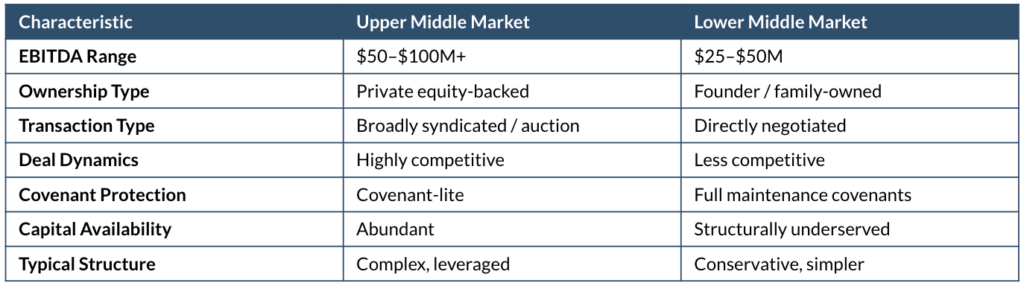
Lower middle market companies represent the vast majority of middle market businesses, more than 90% by company count, and play an important role in economic activity both domestically and globally.
Why is the lower middle market structurally underserved?
The lower middle market remains structurally underserved. Traditional banks have retrenched from relationship-based lending due to regulatory capital requirements and reduced risk tolerance, making smaller, bespoke loans less economical. Meanwhile, large private credit platforms are oriented toward the upper middle market, their fund sizes require deploying substantial capital per transaction, pushing them toward larger, sponsor-backed deals with greater deployment velocity.
As a result, capital is less abundant in the lower middle market, where underwriting is more relationship-driven and sourcing requires deeper local networks. This creates a favorable supply-demand imbalance for disciplined lenders, transactions are privately negotiated rather than broadly auctioned, allowing lenders to maintain pricing power and structure loans with more conservative leverage and stronger documentation.
How can the lower middle market offer stronger structures and downside protection?
Given that lower middle market companies are typically led by founders or management teams who retain significant equity ownership alignment fosters a long-term orientation focused on stability and prudent growth rather than financial engineering. In contrast to upper middle market private credit deals, which may involve dividend recapitalizations, aggressive leverage, or complex capital structures, non-sponsored transactions tend to feature simpler structures and more conservative balance sheets. This simplicity enhances transparency and reduces the risks associated with incremental debt layering or EBITDA adjustments.
One of the most important differentiators in non-sponsored lower middle market private credit is covenant protection. Unlike many upper middle market private credit deals that are covenant-lite, lower middle market deals frequently include maintenance covenants such as leverage tests and fixed charge coverage ratios. These covenants serve as early warning systems, enabling lenders to identify underperformance and engage constructively with borrowers before liquidity becomes impaired. Strong documentation typically also includes comprehensive collateral packages, tight limitations on restricted payments and additional indebtedness, and first lien senior secured positioning. In certain cases, personal guarantees or meaningful equity support further enhance downside protection. These structural features materially improve recovery prospects and help mitigate tail risk.
What are the durable tailwinds supporting the lower middle market?
Secular tailwinds further support the long-term opportunity set. Continued bank retrenchment heightened regulatory scrutiny, and the growing need for customized, flexible financing solutions all reinforce the role of private lenders in serving smaller businesses.
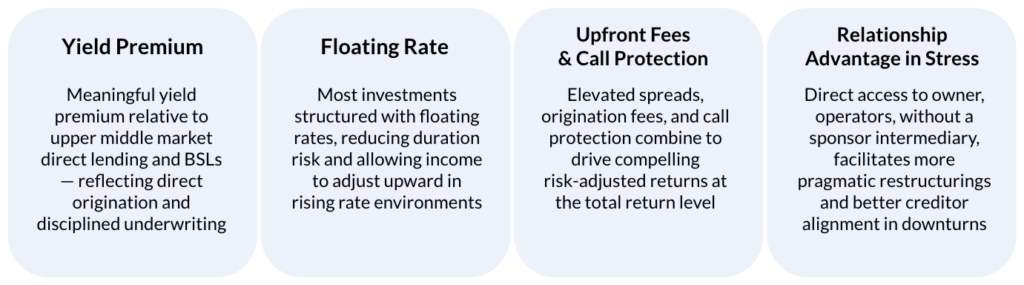
At the same time, demographic trends, including aging founders seeking liquidity or succession solutions—create sustained demand for non-sponsored capital. Taken together, lower middle market private credit offers a differentiated combination of higher yields, stronger covenant protection, conservative leverage, and reduced competitive intensity.
For investors seeking resilient income and enhanced downside protection within private markets, this segment represents a particularly attractive allocation. In an environment where underwriting discipline and structural rigor are increasingly critical, non-sponsored lower middle market lending stands out as a strategy well-positioned to deliver durable, risk-adjusted returns.
Acknowledgment and Disclaimers
1. Source: Wall Street Oasis, Lower Middle Market, 2024. Available at: www.wallstreetoasis.com/resources/skills/valuation/lower-middle-market
The materials contained herein are for information purposes only and do not constitute an offer to sell or a solicitation of an offer to purchase any interest in any investment vehicles.
Statements contained herein reflect the subjective views and opinion of Sagard and may not be able to be independently verified. These materials are being provided solely for informational purposes and are not intended to be, and shall not be regarded or construed as, rendering accounting, business, financial, investment, legal, tax, or other professional advice or services, nor as a recommendation for a transaction or investment, including without limitation an offer to purchase, sell or hold any security investment, loan or other financial product or to enter into or arrange any type of transaction. This publication is not a substitute for such professional advice or services, nor should it be used as a basis for any decision or action that may affect your business. Before making any decision or taking any action that may affect your business, you should consult a qualified professional advisor. Sagard shall not be responsible for any loss sustained by any person who relies on this publication.
Like all investments, an investment in private markets involves the risk of loss. Investment products such as private market investments are designed only for sophisticated investors who can sustain the loss of their investment. Accordingly, such investment products are not suitable for all investors. Private market investments are not subject to the same or similar regulatory requirements as mutual funds or other more regulated collective investment vehicles.
Certain statements and certain of the information contained in these materials represents or is based upon “forward-looking” statements or information based on experience and expectations about these types of investments. The forward-looking statements in these materials include statements with respect to, among other things, projections, forecasts or estimates of cash flows, yields or returns, scenario analyses or proposed or expected portfolio composition and anticipated future events, performance or expectations. Forward-looking statements are inherently uncertain and are not guarantees of future performance and are subject to many risks, uncertainties and assumptions that are difficult to predict. No representation or warranty, express or implied, is made as to any forward-looking statements and information and no undue reliance should be placed on such forward-looking statements and information. Sagard has no obligation and does not undertake to revise or update these materials or any forward-looking statements set forth herein, except as required by law.
The information in the attached materials reflects the general intentions of Sagard. There can be no assurance that these intentions will not change or be adjusted to reflect the environment in which Sagard will operate.
Past performance and historic information is not necessarily indicative of future activities or returns, and there can be no assurance that comparable results will be achieved.
No securities commission or regulatory authority in Canada has in any way passed upon the merits of an investment in private markets or the accuracy or adequacy of the information or material contained herein or otherwise.
The information contained herein is in summary form for convenience of presentation. It is not complete and it should not be relied upon as such. Sagard makes no representation or warranty, express or implied, as to the accuracy or completeness of the information contained herein.
All information is presented as of April 2026 unless otherwise stated.
Sagard Holdings Manager (Canada) Inc. is registered as an exempt market dealer in the provinces of British Columbia, Alberta, Manitoba, Ontario, Quebec, and Nova Scotia. The Ontario Securities Commission is the Principal Regulator of Sagard Holdings Manager (Canada) Inc.