

Stephen Harvey
Chief Investment Officer
Sagard Wealth
The Risk You Want to Take—and the Risk You Can Afford to Take
This piece is a rewrite of a piece I wrote two years ago and is the piece I most often refer to when meeting new potential clients. Today’s note is about how our relationship with investment risk changes over time.
Risk Tolerance has two parts:
- Your willingness to take risk: How comfortable are you watching your portfolio rise and fall?
- Your ability to take risk: How much financial damage could you absorb without changing your lifestyle or long-term plans?
The two do not always move together. As people get older, their willingness to take risk often declines. Yet their financial ability to take risk may increase as they accumulate wealth. The important question, however, is not simply how much risk you can take. It is how much risk you need to take.
A couple of years ago, I listened to an excellent episode of the Value After Hours podcast featuring Luca Dellanna. Luca has written extensively about a concept called ergodicity. The word sounds as though it belongs in a university statistics department, preferably behind a door nobody opens. Fortunately, the basic idea is much simpler:
An investment strategy can look attractive “on average” and still produce a terrible outcome for the person actually living through it.
Why? Because averages often ignore the order in which events happen—and whether one bad event prevents you from continuing. Two examples help to bring this to life.
Downhill Skiing
Imagine a talented downhill skier who competes very aggressively. In every race, the skier has a 20% chance of winning. With ten races in a season, it may seem reasonable to expect two victories. There is just one small problem: the skier also has a 20% chance of crashing and breaking a leg in each race. Once that happens, the season is over.
Our fearless skier may have the talent to win two races, but talent is less useful when viewed from a hospital bed. Once we account for the possibility that a crash ends the season early, the expected number of victories falls to roughly 0.7.
Investing works in much the same way.
Suppose an investor has a 20% chance of doubling an investment—but also a 20% chance of losing half of it. The upside sounds exciting, particularly when described over dinner. The downside is less charming.
A 50% loss requires a 100% gain just to get back to where you started:
- $100 falling by 50% becomes $50.
- $50 must then rise by 100% to return to $100.
This is why avoiding large losses matters so much. A less dramatic strategy with more modest gains and smaller setbacks can produce a much better long-term result. In investing, staying on the mountain is often more important than winning a particular race.
Frank v Jane
Now consider two investors: Frank and Jane. Frank enjoys excitement. He is comfortable with annual returns ranging from a 25% loss to a 25% gain. His portfolio has excellent stories, strong opinions and, occasionally, some explaining to do.
Jane prefers a quieter life. Her annual returns range from a 7% loss to a 10% gain. She is unlikely to dominate a cocktail-party conversation, but she also sleeps rather well.
Now imagine 1,000 Franks and 1,000 Janes, each starting with $1 million. We simulate their investment results over 25 years. At the top of the rankings, the Franks dominate. The wealthiest investors are all Franks, and the richest Jane does not appear until number 14.
At first glance, Frank’s strategy looks superior. But looking only at the winners is like studying lottery winners to determine whether buying lottery tickets is a sound retirement plan.
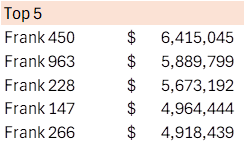
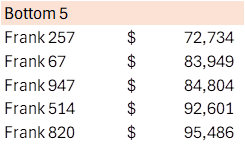
Now look at the bottom of the rankings. Several Franks come close to being wiped out. The five worst-performing Franks lose more than 90% of their original wealth. Jane’s results are less spectacular at the top, but far less frightening at the bottom.
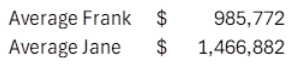
Finally, consider the typical experience. After 25 years, the average Frank has made little progress, while Jane’s slower and steadier approach has done a much better job of preserving and compounding wealth.
Frank wins the headlines. Jane wins the long game.
What This Means for Wealth Management
Many successful wealth-management clients began their careers as Franks—or as downhill skiers. Entrepreneurs often create wealth by concentrating their efforts, taking calculated risks and backing themselves when others will not. Those qualities can be enormously valuable when building a company.
But the strategy that creates wealth is not always the strategy that preserves it. Building a business may require concentration. Preserving a family’s wealth usually requires diversification. Entrepreneurship rewards boldness; wealth management often rewards resilience.
This creates one of the more delicate conversations in financial advice: helping someone recognize that the game has changed. Earlier in life, the goal may have been to create wealth. Later, the goal may be to protect that wealth, fund a lifestyle, support a family and leave something meaningful behind.
At that point, the question is no longer: “How much could I make?” It becomes: “What could go wrong, and would I still be financially secure if it did?”
For many successful investors, the answer is not to stop taking risk altogether. It is to take risk more deliberately—to accept enough risk to meet their goals, but not so much that one bad outcome can knock them out of the game.
There comes a time when the downhill skier should consider moving to a gentler slope—and when Frank might benefit from borrowing a page from Jane’s playbook.
That may sound less exciting. But preserving wealth is allowed to be boring. In fact, boring is often a feature, not a bug.
For those interested in learning more, Luca Dellanna’s books are available here. I particularly recommend Winning Long-Term Games, especially for younger investors and the next generation of family wealth holders.