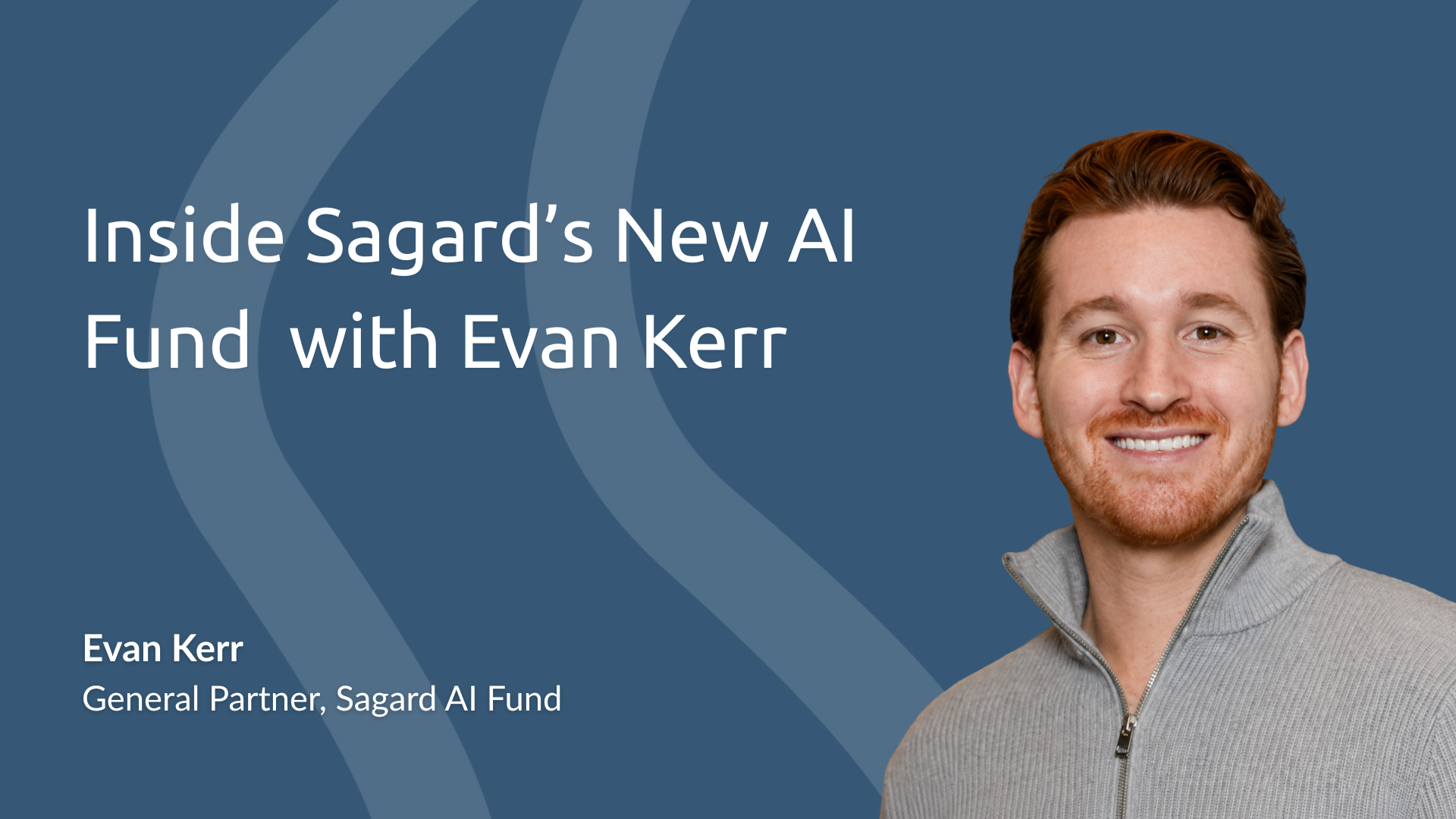
Sagard recently launched a new AI investment strategy with the goal of backing the companies shaping the next decade of artificial intelligence. The Sagard AI Fund is a newly established US$150 million fund backed by Power Corporation, Great-West Lifeco, and IGM Financial.
We sat down with Evan, General Partner, to discuss why Sagard is entering the AI market now, where he sees the strongest opportunities, and what enterprises need to understand as AI moves from experimentation to real deployment.
“Most enterprises think they are experimenting with AI. In five years, they will realize this was the moment they fell behind or pulled ahead”
Why was it created?
The Sagard AI Fund is a new venture strategy focused on backing leading AI companies globally. It was created to invest across the AI landscape, including horizontal AI, vertical AI, and infrastructure.
The opportunity is broad by design. AI is not limited to one industry or one type of use case. We expect to see meaningful companies emerge across financial services, healthcare, real estate, manufacturing, travel, and other major parts of the global economy.
At the same time, this fund is about more than capital. Sagard and Power Corporation have deep networks, operating experience, and global relationships that can help founders accelerate their growth. For the right companies, that ecosystem can be highly valuable.
What makes Sagard’s approach distinctive?
Sagard has a vantage point that is hard to replicate. On one end of the spectrum, through Diagram Ventures, we can see companies at the very earliest stage, sometimes when they are still just an idea. On the other end, we have deep relationships with large enterprises, including many in regulated sectors that are working through the complexity of AI deployment.
That matters because building a great AI company is not only about having impressive technology. The winners also need to understand enterprise workflows, procurement, governance, legacy systems, change management, and integration.
Many investors have either an early-stage view or an enterprise view. Sagard has visibility from company formation through to large-scale enterprise adoption. That gives us a better understanding of where the real pain points are and which companies are best positioned to solve them.
What themes are you most excited about?
One major area is AI infrastructure. As enterprises adopt AI, they need better tools to manage data transformation, model evaluation, observability, model routing, and cost optimization.
Model routing is a good example. Not every task needs to be handled by the most expensive frontier model. In many cases, a smaller or lower-cost model may be enough. Helping companies make those decisions intelligently will become increasingly important.
Beyond infrastructure, we are looking closely at cybersecurity, governance, customer experience, employee engagement, and agentic workflows. We are especially interested in how agents will change the way employees and customers interact with software.
Broadly, our focus areas include AI infrastructure, cybersecurity, agentic customer experience, employee engagement, enterprise productivity, AI-enabled services, and autonomous systems of action.
“A lot of companies have run pilots. Very few have actually changed how they operate. That gap is where the real opportunity sits”
How do you think AI will change the enterprise over the next few years?
Over the next three to five years, I expect the proliferation of agents across organizations to significantly increase the speed of work. The way people interact with software, manage workflows, and make decisions is going to change quickly.
That is one of the reasons this is such an exciting time to invest in enterprise software. Some companies in this market are growing faster than we have ever seen before.
What do you think people misunderstand about AI adoption?
There is a tendency to talk about AI as if it solves everything. The reality is more nuanced. AI is a transformational trend, but successful adoption is not simply a technology problem.
Enterprises still need strong change management. They need teams that work well together. They need a clear mission and a focused set of use cases. Without that, even powerful technology can fail to create meaningful value.
I think we are entering a more disciplined phase of AI adoption. Companies will become more methodical about where they deploy AI and will focus more on the use cases that can create measurable impact.
“Technology is rarely what holds companies back. Getting the right people aligned around the right problems is what actually determines whether AI creates value or just creates noise.”
What are you watching most closely in the AI market right now?
One thing we are watching is the amount of liquidity that may come into the AI ecosystem. If some of the largest AI companies enter the public markets, that could create a powerful reinvestment cycle across the broader technology landscape.
The second thing is model performance. Over the last few years, frontier models and open-source models have improved at an extraordinary pace. A key question is whether that rate of improvement continues, or whether performance gains begin to moderate.
That will have important implications for competitive dynamics. If models become more comparable over time, the value may shift toward infrastructure, workflow ownership, distribution, and the ability to solve specific enterprise problems.
Do you expect AI costs to keep rising?
Cost optimization is going to be a major theme. Enterprises are already focused on the cost of using frontier models, and I expect vendors to respond with more flexible and efficient options.
Open-source models will also become more important as companies look for lower-cost alternatives. My view is that AI costs are more likely to be lower twelve months from now than higher.
”The companies that win will not be the ones with the best AI. They will be the ones that rewired their entire operation around it and did it first”
The companies that matter most will not only create new tools. They will change workflows, decision-making, customer interactions, and employee productivity at scale.
That is the opportunity we are investing behind.
To learn more about Sagard’s AI Fund or connect with Evan Kerr, please contact our team at [email protected]