What’s in this article
- How do buyout, growth equity, and venture capital fit across the private equity lifecycle?
- What is buyout investing?
- What is growth equity?
- What is venture capital?
- How do buyout, growth equity, and venture capital compare?
- Closing thoughts
Primaries, secondaries, and co-investments are three complementary routes into private equity, but another equally important lens is what you are underwriting once you get there: the company’s stage, its cash flow profile, and the mix of value and growth that drives returns.
Public market investors often separate portfolios into value (cash flows today, priced with discipline) and growth (cash flows tomorrow, priced on potential). In private markets, those same concepts still apply, but they manifest through strategy choices and deal structures. Venture capital, growth equity, and buyout each represent a distinct way to balance value and growth levers across a company’s lifecycle, and they tend to complement one another in a well-built program.
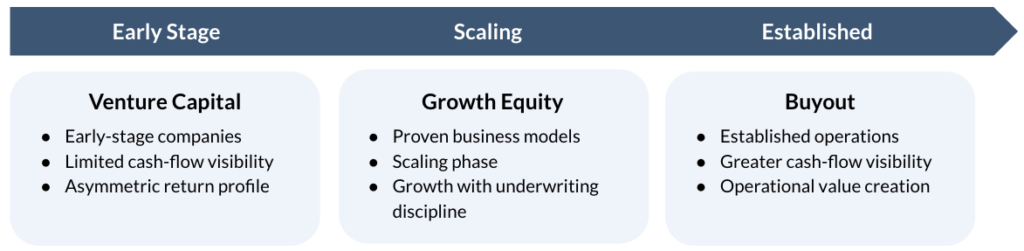
How do buyout, growth equity, and venture capital fit across the private equity lifecycle?
What is buyout investing?
Buyout investing typically involves acquiring a controlling stake in a more mature company, often with meaningful revenue, established customers, and clearer cash flow visibility. The sponsor generally takes an active governance role and executes a defined value creation plan over a multi-year holding period, ultimately exiting via a sale, recapitalization, or public listing.
In many respects, buyouts align most closely with underwriting current fundamentals and improving intrinsic value over time.
Primary Return Drivers
- Operational improvement, including margin expansion and productivity gains
- Strategic repositioning, including product mix and selective M&A
- Disciplined capital structure management
Risk Characteristics
- Greater visibility into cash flows relative to earlier-stage strategies
- Execution risk tied to operational and strategic change
- Exposure to leverage, where used
What is growth equity?
Growth equity generally sits between buyout and venture. These companies are typically beyond early product-market risk: they have a proven offering, growing demand, and a credible path to scale. Investments are often minority positions (though structures vary), with governance rights and alignment mechanisms designed to support growth while protecting the downside.
Primary Return Drivers
- Expanding sales capacity and market reach
- New product development or geographic expansion
- Professionalization of systems, talent, and governance
Risk Characteristics
- Moderate cash-flow visibility
- Dependence on sustained revenue growth
- Execution risk around scaling operations
What is venture capital?
Venture capital targets companies earlier in their development, where product, market, and execution risks are higher. Capital is typically deployed across financing rounds as milestones are achieved.
In public market terms, venture often behaves like long-duration growth (or even a portfolio of options) where outcomes can be asymmetric. A smaller number of successful investments may drive a significant portion of overall returns, making manager selection, portfolio construction, and follow-on decisioning especially important.
Primary Return Drivers
- Establishing product-market fit
- Rapid revenue growth and market adoption
- Building durable competitive advantage
Risk Characteristics
- Limited or negative cash flows in early years
- Evolving business models
- Wider range of potential outcomes
How do buyout, growth equity, and venture capital compare?
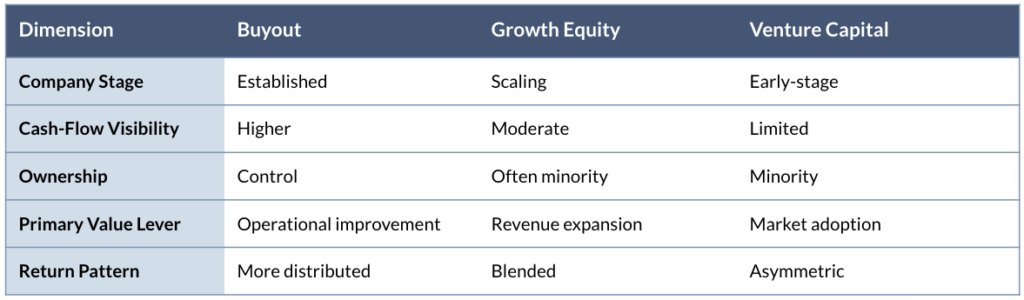
Putting it all together, primaries, secondaries, and co-investments are access tools that can be used across all three strategies. Investors can commit to buyout, growth, or venture via primary funds; reshape exposure through secondaries; and selectively add precision via co-investments. Each reinforces a more intentional approach to portfolio design.
Closing thoughts
In our view, a thoughtful private markets allocation starts with clarity on what you want to own (buyout, growth, venture) and then pairs it with how you want to access it (primaries, secondaries, co-investments). The result is a toolkit designed to balance value and growth levers across companies, cycles, and time.
Acknowledgment and Disclaimers
The materials contained herein are for information purposes only and do not constitute an offer to sell or a solicitation of an offer to purchase any interest in any investment vehicles.
Statements contained herein reflect the subjective views and opinion of Sagard and may not be able to be independently verified. These materials are being provided solely for informational purposes and are not intended to be, and shall not be regarded or construed as, rendering accounting, business, financial, investment, legal, tax, or other professional advice or services, nor as a recommendation for a transaction or investment, including without limitation an offer to purchase, sell or hold any security investment, loan or other financial product or to enter into or arrange any type of transaction. This publication is not a substitute for such professional advice or services, nor should it be used as a basis for any decision or action that may affect your business. Before making any decision or taking any action that may affect your business, you should consult a qualified professional advisor. Sagard shall not be responsible for any loss sustained by any person who relies on this publication.
Like all investments, an investment in private markets involves the risk of loss. Investment products such as private market investments are designed only for sophisticated investors who can sustain the loss of their investment. Accordingly, such investment products are not suitable for all investors. Private market investments are not subject to the same or similar regulatory requirements as mutual funds or other more regulated collective investment vehicles.
Certain statements and certain of the information contained in these materials represents or is based upon “forward-looking” statements or information based on experience and expectations about these types of investments. The forward-looking statements in these materials include statements with respect to, among other things, projections, forecasts or estimates of cash flows, yields or returns, scenario analyses or proposed or expected portfolio composition and anticipated future events, performance or expectations. Forward-looking statements are inherently uncertain and are not guarantees of future performance and are subject to many risks, uncertainties and assumptions that are difficult to predict. No representation or warranty, express or implied, is made as to any forward-looking statements and information and no undue reliance should be placed on such forward-looking statements and information. Sagard has no obligation and does not undertake to revise or update these materials or any forward-looking statements set forth herein, except as required by law.
The information in the attached materials reflects the general intentions of Sagard. There can be no assurance that these intentions will not change or be adjusted to reflect the environment in which Sagard will operate.
Past performance and historic information is not necessarily indicative of future activities or returns, and there can be no assurance that comparable results will be achieved.
No securities commission or regulatory authority in Canada has in any way passed upon the merits of an investment in private markets or the accuracy or adequacy of the information or material contained herein or otherwise.
The information contained herein is in summary form for convenience of presentation. It is not complete and it should not be relied upon as such. Sagard makes no representation or warranty, express or implied, as to the accuracy or completeness of the information contained herein.
All information is presented as of March 2026 unless otherwise stated.
Sagard Holdings Manager (Canada) Inc. is registered as an exempt market dealer in the provinces of British Columbia, Alberta, Manitoba, Ontario, Quebec, and Nova Scotia. The Ontario Securities Commission is the Principal Regulator of Sagard Holdings Manager (Canada) Inc.