
Stephen Harvey
Chief Investment Officer
Sagard
What’s in this article
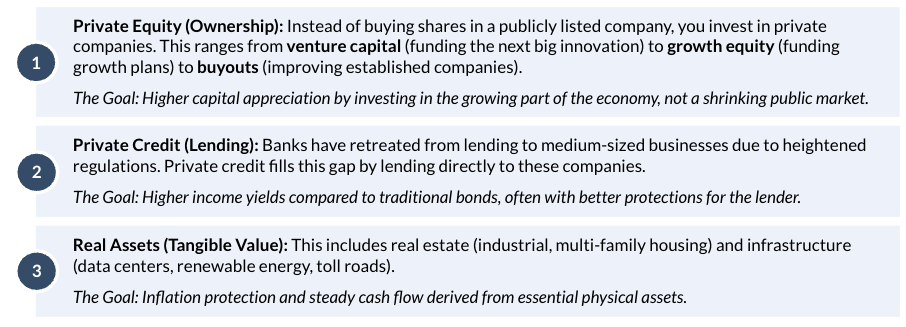
- What are the three main types of private market investments?
- Why consider private markets?
- How should investors think about liquidity?
- What should investors know before investing in private markets?
- The bottom line
For decades, the “60/40” portfolio (60% public stocks, 40% bonds) was the practical model for investing. But the financial world has changed. As public markets become more crowded and concentrated, sophisticated investors, from pension funds to endowments, have shifted their focus to a third pillar of investing: private markets.
This guide explains what private markets are, why they are becoming essential for modern portfolios, and how they might fit into your long-term wealth strategy.
What are the three main types of private market investments?
Why consider private markets?
A Broader Opportunity Set
Restricting yourself to the public stock market means missing out on the vast majority of the “real” economy. Today, companies are staying private longer, and there are approximately 7x more private companies (with revenues over $100M) than there are public companies.1 Private markets open the door to this wider investable universe.
Enhanced Return & Income Potential
Private markets offer different engines for performance. Private equity managers can actively intervene in a company’s operations to create value (growth), while private credit and real assets can provide robust cash flows (income), which are particularly attractive when traditional bond yields are low.
True Diversification
In recent years, stocks and bonds have often moved in tandem—when one goes down, the other often follows. Private markets historically have different “return drivers,” meaning they don’t always react to the daily news cycle the way stocks and bonds do. This helps reduce the “sameness” in your portfolio, especially when mutual funds and ETFs are invested in the same public names.
Reduced Volatility
Because these assets are not traded on a public exchange every second, they are not subject to the daily emotional pricing swings of the stock market. This “smoothing” effect can result in a more stable portfolio value over time, helping investors stay the course during periods of market stress.
How should investors think about liquidity?
The most important difference between investing in public and private markets is liquidity. You cannot sell private assets with the click of a button like you can with a public stock or mutual fund.
This lack of liquidity is a feature, not a bug. It is the price one pays for the illiquidity premium. Historically, investors have been rewarded with higher potential returns as compensation for locking up their capital.
Work with a wealth advisor to discuss your investment goals and determine your liquidity budget. The table below provides an overview, but your own personal target allocation should be discussed with an investment professional.
| Bucket | Time Horizon | Strategy |
| Immediate | < 1 year | Cash & Equivalents: Safety and instant access. |
| Core | 1–5 years | Public Stocks & Bonds: Market growth and flexibility. |
| Strategic | 5+ years | Private Markets: Capital you don’t need to touch, allowing you to capture the illiquidity premium over time. |
Taking a strategic approach: Do you have a portion of wealth that you definitely will not need to access in the next few years? If the answer is yes, that capital may be “under-employed” in the public markets.
What should investors know before investing in private markets?
While the benefits are compelling, private markets require a different mindset:
- Valuation: Unlike stocks that trade and are priced every second, private assets are valued monthly or quarterly. This smooths volatility, but requires trust in the manager’s discipline.
- Transparency: You won’t see a daily ticker symbol. Reporting is detailed but less frequent than public markets.
- Complexity & Fees: Sourcing private deals is labour-intensive. Consequently, fees are typically higher than passive index funds to cover the active management required to generate returns.
The bottom line
Private markets are not a replacement for your core portfolio—they are a complement designed to add resilience, income, and long-term growth potential.
1. Source: US Census Bureau – Statistics of US Businesses database as of December 2023, which represents latest data available through 2021. Public company count is from the World Federation of Exchanges database as of June 2024.
Acknowledgment and Disclaimers
The materials contained herein are for information purposes only and do not constitute an offer to sell or a solicitation of an offer to purchase any interest in any investment vehicles.
Statements contained herein reflect the subjective views and opinion of Sagard and may not be able to be independently verified. These materials are being provided solely for informational purposes and are not intended to be, and shall not be regarded or construed as, rendering accounting, business, financial, investment, legal, tax, or other professional advice or services, nor as a recommendation for a transaction or investment, including without limitation an offer to purchase, sell or hold any security investment, loan or other financial product or to enter into or arrange any type of transaction. This publication is not a substitute for such professional advice or services, nor should it be used as a basis for any decision or action that may affect your business. Before making any decision or taking any action that may affect your business, you should consult a qualified professional advisor. Sagard shall not be responsible for any loss sustained by any person who relies on this publication.
Like all investments, an investment in private markets involves the risk of loss. Investment products such as private market investments are designed only for sophisticated investors who can sustain the loss of their investment. Accordingly, such investment products are not suitable for all investors. Private market investments are not subject to the same or similar regulatory requirements as mutual funds or other more regulated collective investment vehicles.
Certain statements and certain of the information contained in these materials represents or is based upon “forward-looking” statements or information based on experience and expectations about these types of investments. The forward-looking statements in these materials include statements with respect to, among other things, projections, forecasts or estimates of cash flows, yields or returns, scenario analyses or proposed or expected portfolio composition and anticipated future events, performance or expectations. Forward-looking statements are inherently uncertain and are not guarantees of future performance and are subject to many risks, uncertainties and assumptions that are difficult to predict. No representation or warranty, express or implied, is made as to any forward-looking statements and information and no undue reliance should be placed on such forward-looking statements and information. Sagard has no obligation and does not undertake to revise or update these materials or any forward-looking statements set forth herein, except as required by law.
The information in the attached materials reflects the general intentions of Sagard. There can be no assurance that these intentions will not change or be adjusted to reflect the environment in which Sagard will operate.
Past performance and historic information is not necessarily indicative of future activities or returns, and there can be no assurance that comparable results will be achieved.
No securities commission or regulatory authority in Canada has in any way passed upon the merits of an investment in private markets or the accuracy or adequacy of the information or material contained herein or otherwise.
The information contained herein is in summary form for convenience of presentation. It is not complete and it should not be relied upon as such. Sagard makes no representation or warranty, express or implied, as to the accuracy or completeness of the information contained herein.
All information is presented as of November 2025 unless otherwise stated.
Sagard Holdings Manager (Canada) Inc. is registered as an exempt market dealer in the provinces of British Columbia, Alberta, Manitoba, Ontario, Quebec, and Nova Scotia. The Ontario Securities Commission is the Principal Regulator of Sagard Holdings Manager (Canada) Inc.