
What’s in this article
- What are primaries?
- What are secondaries?
- What are co-investments?
- How do primaries, secondaries, and co-investments complement one another?
- Closing thoughts
Private equity has evolved from a single allocation decision into a set of complementary tools that can be combined to build more intentional exposure. For many investors, the question is no longer simply, “Should we allocate to private equity?” but rather, “How do we build a program that is durable across cycles, disciplined in underwriting, and aligned with our portfolio objectives?”
Three approaches sit at the center of most institutional private equity programs: primaries, secondaries, and co-investments. Each is a different entry point to the same asset class. Each comes with its own mechanics, timeline, and risk-return profile. Importantly, when used together, they can create a more balanced, flexible private equity program than any single approach on its own.
What are primaries?
Primaries are the most familiar route into private equity. In a primary commitment, an investor commits capital to a private equity fund, typically during the fund’s fundraising period. That committed capital is then called over time as the manager identifies and executes new investments.
Mechanically, primaries are built around a multi-year investment period. Investors do not invest all their capital on day one. Instead, they fund capital calls as deals are completed. Over time, the fund builds a diversified portfolio, seeks to improve the underlying companies, and ultimately returns capital through realizations and distributions later in the fund’s life.
Because of that pacing, primaries tend to exhibit the classic J-curve dynamic: early net outflows and fees as the portfolio is assembled, followed by potential distributions as value is realized. The primary market, however, remains foundational because it offers what investors most often seek: access to a manager’s sourcing engine, a repeatable investment process, sector expertise, and portfolio construction discipline. In many ways, primaries establish the relationship “spine” of a private equity program and create a steady cadence of exposure to new vintages over the years.
What are secondaries?
Secondaries offer a different way to access private equity: rather than committing to a fund before it invests, an investor purchases an existing interest in a private equity fund or portfolio.
Secondaries generally fall into two broad categories:

At a practical level, the defining feature of secondaries is that investors typically buy into a portfolio that is already partially or fully invested. That changes the experience: underwriting is more focused on existing assets, current valuation, and the visibility into future cash flows, rather than forecasting what a manager might buy over the next several years.
Because assets are more seasoned, secondaries can provide a different duration and cash flow profile than primaries, often reducing the depth or length of the J-curve. They can also function as a portfolio management tool, allowing investors to increase or reduce exposures by vintage, strategy, manager, or sector with greater immediacy than waiting for a primary program to rebalance over time.
The nuance is important: not all secondaries are alike. A diversified LP portfolio requires a different underwriting lens than a concentrated GP-led transaction focused on a small number of assets. The common thread is that secondaries convert what is often perceived as an “illiquid” asset class into a more actively managed exposure, where entry points, pricing, alignment, and structure matter deeply.
What are co-investments?
Co-investments sit somewhere between fund investing and direct investing. In a co-investment, an investor participates directly in a specific transaction alongside a lead sponsor, usually a private equity manager already known to the investor. Rather than gaining exposure through a blind-pool fund portfolio, the investor evaluates and invests in an individual company or asset at the time of the deal.
Co-investments are often attractive for three reasons:
- Specificity: Investors can focus on particular sectors, themes, or deal types that align with their objectives
- Transparency: Underwriting is centered on a defined asset, with a clear value creation plan and deal structure
- Economics: Co-investments are frequently offered on reduced fee and carry terms relative to commingled fund commitments, potentially improving net efficiency (while still requiring disciplined underwriting and risk sizing)
At the same time, co-investments require a different operating model. They tend to be more time-sensitive, with diligence conducted on a deal timetable. They can also introduce concentration risk if not thoughtfully sized within a broader portfolio. In other words, co-investments can be a powerful complement to funds, but they work best when integrated into a program with clear underwriting standards and portfolio construction guardrails.
How do primaries, secondaries, and co-investments complement one another?
While each approach can stand on its own, the most resilient private equity programs treat primaries, secondaries, and co-investments as interlocking components:
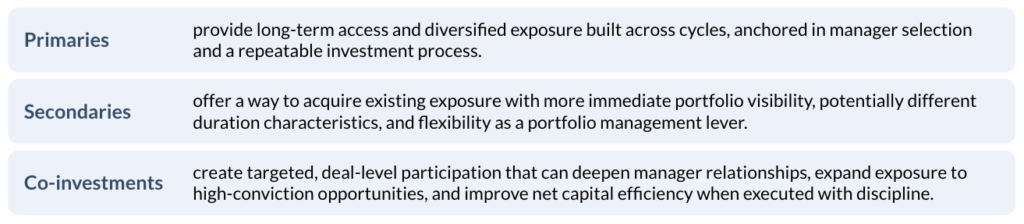
Used together, these three routes can help investors balance relationship-driven access (primaries), portfolio shaping and pacing flexibility (secondaries), and selective precision (co-investments). Rather than asking which one is “best,” many investors are increasingly focused on how the combination can create a more intentional program. A program that can be paced, diversified, and adjusted as markets and portfolio needs evolve.
Closing thoughts
Private equity is not a one-size-fits-all allocation. Primaries, secondaries, and co-investments are three distinct ways to participate, each with different mechanics and advantages. When thoughtfully integrated, they can form a more complete toolkit: one designed to build durable exposure, navigate changing market conditions, and pursue opportunities with discipline.
If you’re evaluating how these approaches can fit together within your portfolio, we welcome the conversation. Our focus is on helping investors build private equity exposure with a balanced toolkit, rigorous underwriting, and long-term alignment.
Acknowledgment and Disclaimers
The materials contained herein are for information purposes only and do not constitute an offer to sell or a solicitation of an offer to purchase any interest in any investment vehicles.
Statements contained herein reflect the subjective views and opinion of Sagard and may not be able to be independently verified. These materials are being provided solely for informational purposes and are not intended to be, and shall not be regarded or construed as, rendering accounting, business, financial, investment, legal, tax, or other professional advice or services, nor as a recommendation for a transaction or investment, including without limitation an offer to purchase, sell or hold any security investment, loan or other financial product or to enter into or arrange any type of transaction. This publication is not a substitute for such professional advice or services, nor should it be used as a basis for any decision or action that may affect your business. Before making any decision or taking any action that may affect your business, you should consult a qualified professional advisor. Sagard shall not be responsible for any loss sustained by any person who relies on this publication.
Like all investments, an investment in private markets involves the risk of loss. Investment products such as private market investments are designed only for sophisticated investors who can sustain the loss of their investment. Accordingly, such investment products are not suitable for all investors. Private market investments are not subject to the same or similar regulatory requirements as mutual funds or other more regulated collective investment vehicles.
Certain statements and certain of the information contained in these materials represents or is based upon “forward-looking” statements or information based on experience and expectations about these types of investments. The forward-looking statements in these materials include statements with respect to, among other things, projections, forecasts or estimates of cash flows, yields or returns, scenario analyses or proposed or expected portfolio composition and anticipated future events, performance or expectations. Forward-looking statements are inherently uncertain and are not guarantees of future performance and are subject to many risks, uncertainties and assumptions that are difficult to predict. No representation or warranty, express or implied, is made as to any forward-looking statements and information and no undue reliance should be placed on such forward-looking statements and information. Sagard has no obligation and does not undertake to revise or update these materials or any forward-looking statements set forth herein, except as required by law.
The information in the attached materials reflects the general intentions of Sagard. There can be no assurance that these intentions will not change or be adjusted to reflect the environment in which Sagard will operate.
Past performance and historic information is not necessarily indicative of future activities or returns, and there can be no assurance that comparable results will be achieved.
No securities commission or regulatory authority in Canada has in any way passed upon the merits of an investment in private markets or the accuracy or adequacy of the information or material contained herein or otherwise.
The information contained herein is in summary form for convenience of presentation. It is not complete and it should not be relied upon as such. Sagard makes no representation or warranty, express or implied, as to the accuracy or completeness of the information contained herein.
All information is presented as of February 2026 unless otherwise stated.
Sagard Holdings Manager (Canada) Inc. is registered as an exempt market dealer in the provinces of British Columbia, Alberta, Manitoba, Ontario, Quebec, and Nova Scotia. The Ontario Securities Commission is the Principal Regulator of Sagard Holdings Manager (Canada) Inc.