

Paul Newsome
Partner, Head of Investment Solutions and Capital Formation
Sagard
Private equity as an asset class has only been around since the 1980s. Once a niche reserved for investors with a high risk appetite, the asset class has more than doubled in size in the past decade and now comprises some USD 8trn – USD 10trn in assets.
Private equity has undoubtedly become more mature, more institutional, and more operationally sophisticated during the past 40 years. But over the decades, the industry has also, rightly or wrongly, built up a reputation that the sector is still struggling to shake off – despite its strong growth and increasing importance to investors.
The irony is that many of the strongest opinions about the industry are shaped by a relatively small part of the market people see most often – the mega-buyout world – rather than the broader reality of middle-market investing. Private equity is fundamentally a mid-market business, yet few of these deals account for the coverage shaping almost all of the industry’s public image.
We have been investing in mid-market private equity since those early days in the 1990s, and believe that while these recurring, persistent clichés are not necessarily true or false, they do deserve closer examination.
“Private equity is the most aggressive form of capitalism”
Read the financial press and you will be forgiven for thinking that private equity investors are just ruthless cost-cutters who fire management and cut staff immediately they take control.
In this story, private equity firms acquire a company, load it with debt, cut a few costs, wait for markets to rise and sell at a higher multiple. There is, of course, some truth in this — especially during periods when debt was exceptionally cheap and valuation multiples kept expanding almost regardless of fundamentals.
However, this public image of private equity is disproportionately shaped by very large and highly visible deals involving public companies, restructurings, or iconic consumer brands. Yet the overwhelming majority of private equity investments occur quietly in the mid-market, far from public scrutiny and, as such, the reality is more nuanced.
We would not claim that companies financed by private equity are entirely immune to restructuring – it can and does happen, particularly in more challenging economic environments. And since 2022, higher interest rates have made financial discipline far more visible. Dividend recaps, refinancing pressure, continuation funds, and delayed exits have all attracted increased scrutiny.
Nonetheless, it is still inaccurate to describe private equity as structurally extractive given most successful investments rely on growing businesses rather than stripping them. The real work often consists of rather unglamorous things: recruiting better management teams, improving pricing discipline, investing in systems, making acquisitions, expanding internationally or professionalising businesses that had previously been family-run. Mass redundancies are the exception rather than the rule.
Thus, in most cases, you can invest effectively while remaining true to your values, without going as far as philanthropy.
“Private equity is just about cool consumer goods and tech companies”
Airbnb, Peloton, Canada Goose, Burger King, Dell, Spotify and Uber. Companies all easily identifiable as having been owned by private equity firms.
While these businesses might be viewed as ‘cool’ and ‘on trend’ private equity is, in reality, more about run-of-the-mill, stable businesses. Think funeral homes, bathroom fittings, salmon farms, software and SaaS (software as a service), dental chains and insurance brokers
Why do we love companies like these? The attraction is not rapid disruption or explosive growth, but consistency. We want companies that have predictable, recurring revenues, free cashflow, high margins and sticky customers. Companies that will show resilience through changing macro-economic environments. Businesses where we can look outwards and see an exit strategy even before we have committed to invest.
So while the cool brand may attract a lot of attention, private equity is more about quietly compounding businesses operating in unglamorous, yet resilient sectors of the market.
“Private equity is risky”
Risk is probably the most misunderstood aspect of private equity. Everyone talks about risk, yet people often mean different things when they use the word.
Industry observers can debate whether standard deviation or volatility are appropriate ways to measure risk in private markets, but these measures never tell the full story. They say little about liquidity, timing of cash flows or the time it may take to recoup an investment, or indeed the risk of an investment failing.
The perception that “private equity is risky” may actually stem from the industry’s historical association with venture capital – early-stage companies, start-ups and speculative technology bets where failure rates are usually higher. Venture capital generally involves a different and, in certain respects, higher risk profile than more mature private equity buyouts.
The risk profile of private equity buyouts is very different. Historically, even relatively poor buyout fund performance has often resulted in limited permanent capital loss and illiquidity itself can be a blessing. During the global financial crisis, for example, many highly leveraged buyouts from 2006 and 2007 came under enormous pressure. Some failed while others produced mediocre outcomes.
Yet a surprisingly large number ultimately generated respectable returns because investors had little choice but to remain invested long enough for businesses to recover. In public markets, many investors would likely have sold at the worst possible moment and crystallised their losses.
This does not mean private equity is “safe”, or that leverage is harmless. But the risks in private equity are often different from what people imagine. They are less about day-to-day volatility and more about leverage, liquidity, manager selection and time.
In certain areas of the market, particularly secondaries, acquiring existing portfolios at discounts and with greater visibility into underlying assets may help mitigate certain investment risks. Private equity does not eliminate risk, but it often shifts risk away from short-term market volatility and towards patience, underwriting discipline and the ability to survive difficult periods.
“In private equity, bigger is better”
Scale has enormous prestige in private equity.
The largest firms raise the largest funds, hire the largest teams, and dominate the headlines. This naturally creates the impression that larger buyout funds must also represent safer or superior investments.
The data, however, has often pointed in the opposite direction. Historically, mid-market buyout funds have frequently delivered stronger returns than mega-funds.
There are several reasons for this.
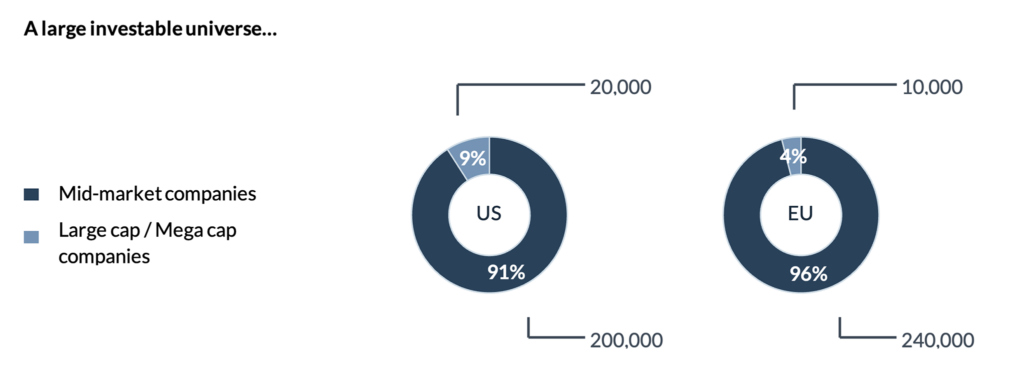
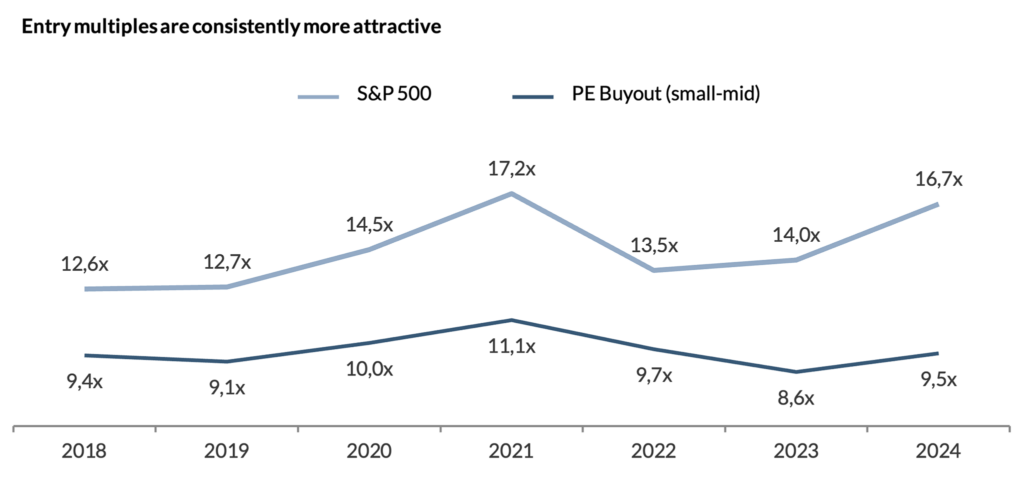
Firstly, the mid-market remains structurally less competitive. There is simply less capital chasing each transaction, which often leads to more reasonable entry valuations.
Past performance is not indicative of future results.
Source: Sagard Research, Bain Global M&A Report, PitchBook, Preqin, Capital IQ, Capstone Partners, Argus Index
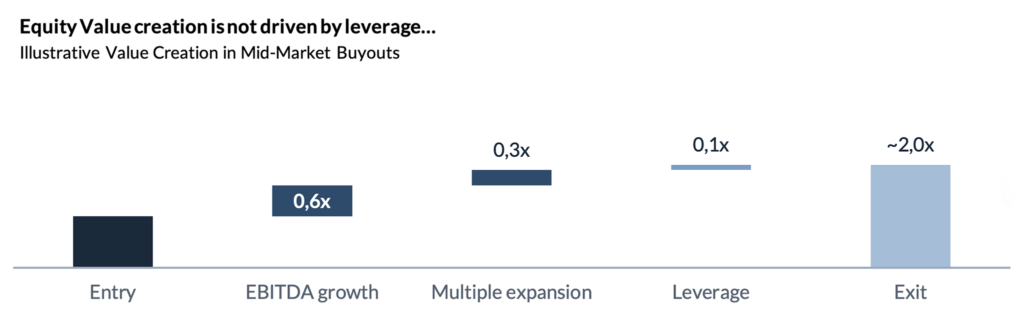
Secondly, operational improvements matter more. In mid-sized companies, value creation frequently comes from tangible actions, such as improving management teams, professionalising operations, expanding geographically, implementing systems or pursuing strategic acquisitions. By contrast, very large buyouts increasingly rely more heavily on financial engineering, multiple arbitrage, and access to capital markets.
Past performance is not indicative of future results.
Source: Sagard Research, Bain Global M&A Report, PitchBook, Preqin, Capital IQ, Capstone Partners, Argus Index
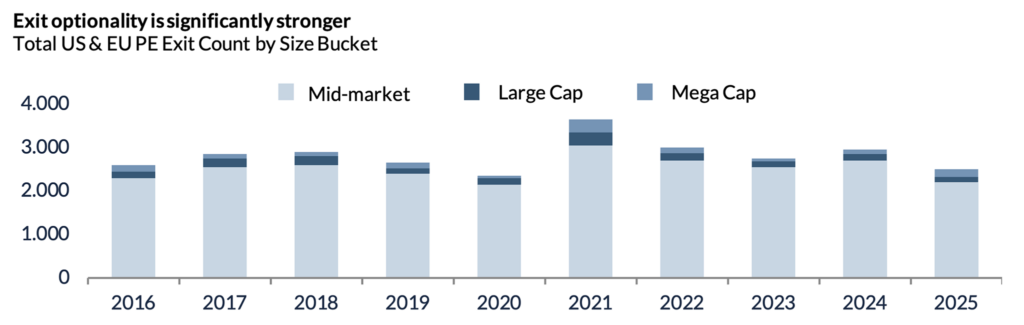
Thirdly, exit options are often broader in the mid-market. A successful mid-sized company typically has a wide range of exit options, including a sale to a strategic buyer, a secondary buyout by a larger private equity firm, an IPO, or a sale to another institutional investor. Large and mega-caps have fewer options. Scale itself can be a constraint, particularly in challenging economic environments.
Past performance is not indicative of future results.
Source: Sagard Research, Bain Global M&A Report, PitchBook, Preqin, Capital IQ, Capstone Partners, Argus Index
Mega-funds also face enormous pressure to deploy capital into an increasingly concentrated pool of large assets. The result is intense competition, elevated valuations, and fewer opportunities for portfolio managers to make a difference.
Past performance is not indicative of future results.
Source: Sagard Research, Bain Global M&A Report, PitchBook, Preqin, Capital IQ, Capstone Partners, Argus Index
Private equity is, in reality, a mid-market business. Read this article to find out more about why we prefer the mid-market.
“Multiples are a more reliable way of measuring performance than IRRs”
Private equity has long relied on two headline metrics: the IRR — broadly, the annualised return on invested capital — and the investment multiple, which measures how much money came back relative to what went in. Conventional wisdom holds that multiples are harder to flatter than IRRs, and there is some truth in this. IRRs can look strongest early in a fund’s life, before slower exits drag them down; a secondary fund that buys at a discount, marks up immediately, and then grinds through years of difficult realisations can post an impressive early IRR that fades quietly over time.
But multiples have their own blind spots. Two funds can report identical 1.8x multiples while delivering very different outcomes for investors — both calling €90m in capital, but one making early distributions such that the maximum “cash out of pocket” for the investor is only €50m.The multiple looks the same; the investor’s bank account is not — a dynamic particularly worth understanding in secondaries, where early distributions can be central to the strategy. Leverage compounds the distortion: borrowing to delay capital calls reduces the denominator and flatters the multiple without changing the underlying portfolio by a single cent.
No single metric tells the whole story, which is why DPI — Distributed to Paid-In capital — has become the most closely watched number since 2022. Slower exits, continuation funds, and asset transfers have blurred the line between realised and unrealised performance. In that environment, cash returned to investors is not just a by-product of performance. It is increasingly the proof of it.
“There is no room for quant in private equity”
Private equity has never had a reputation for algorithmic decision-making, and for good reason: the asset class depends on judgement, negotiation, and information that is often incomplete, inconsistent, or simply unavailable. No model can tell you whether a management team is trustworthy or whether two companies will integrate successfully after a merger.
That said, the idea that technology has no role is increasingly hard to defend. AI tools are now widely used across the industry to screen deals, analyse data rooms, identify operational patterns across portfolios, and sharpen underwriting discipline. What was a competitive differentiator a few years ago has become table stakes. The question is no longer whether to use these tools, but how well, and the answer increasingly depends on proprietary data: an investor with 30 years of detailed performance records, covering deal metrics, financials, sector, geography and GP details, is far better placed to apply AI to investment decisions.
None of this, of course, happens without relationships.
In the last three decades, we have backed managers at the earliest stages of their careers, when they were raising their first or second fund and needed a partner willing to back conviction over track record.
Those relationships tend to endure. The managers we supported when they were emerging are now running established franchises, and we have invested alongside many of them across multiple cycles. That continuity matters — not as a point of pride, but because it shapes the quality of access, information and collaboration that is difficult to replicate without a long shared history.
The mid-market is, ultimately, a people business. The myths we have examined here — about risk, scale, performance metrics, and technology — all dissolve when you have the right partners and of course great businesses that can become market leaders for years to come.