

Stephen Harvey
Chief Investment Officer
Sagard Wealth
I hope everyone had a good Halloween experience. Of late, the markets have been more trick than treat.
Since March, the price of crude oil (and other energy products) has risen rapidly. So rapidly that it has had a material impact on both consumer and producer’s inflation levels. We tend to think about protecting our clients from inflation, which erodes purchasing power, through a combination of assets that are both physical and scarce (real assets). This can be real estate, infrastructure, commodities and gold. Today, the best hedge may well be to hold energy or energy stocks.
No Barrel of Fun
The cost of a barrel of oil has risen significantly over the course of 2026. Exactly how much depends on how you measure it. The most commonly sited price of oil is determined by the front month futures contract. Futures contracts are prices set around delivery on assets at some point in the future and the delivery date is determined by each futures contract. You can trade futures in many commodities, far into the future. If you were to look at the cost of the nearest WTI Crude future, the cost has risen by approximately 80% so far this year. The chart below shows this:
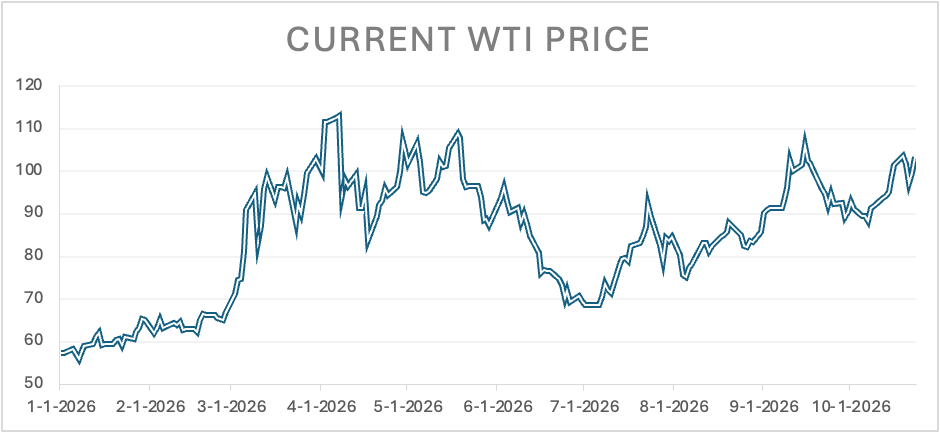
I put together these two charts using price information through October 23rd. The chart above shows the cost of buying 1 barrel of oil, 1 month into the future. As the chart shows, after the initial impacts of the Iran conflict, the price of a barrel jumped to over $110. As of October 23rd, this was over $103. Therefore, although the price of oil has risen throughout the year, on this measure it peaked in April.
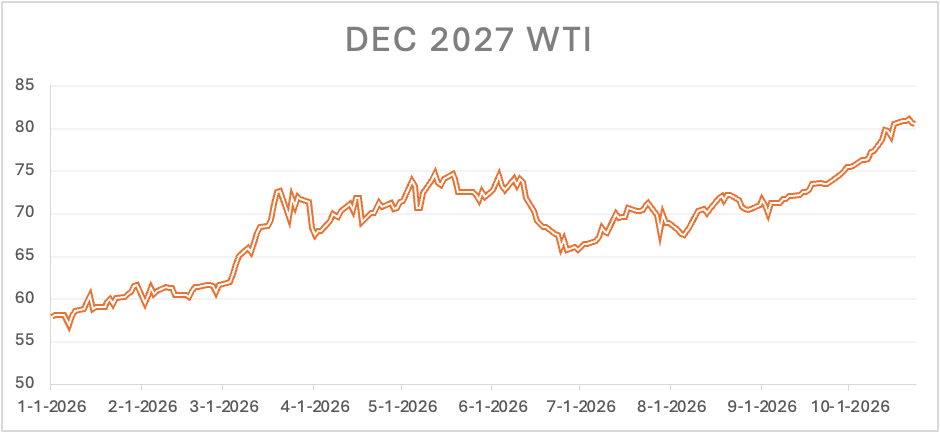
Now let’s look at the future price of a barrel for delivery in December 2027 (calendar 27 as the lingo would go). This measure of priced peaked just a few days ago on October 21st. This is shown in the chart below:
So, why is there such a difference in price, and why the lag in the performance difference?
Contango and Backwardation
Although both terms may sound like dance moves, the terms are ways to describe the difference in prices of spot (today) and future prices. Spot WTI is the price for oil available now; a futures contract is the price agreed today for oil delivered later. Think of it like booking a hotel room: the price for tonight can differ from the price for next summer. With oil, the gap reflects things like storage and financing costs, as well as whether buyers are worried about having enough supply right away. When oil is scarce today, a barrel in hand is worth extra, and spot prices may sit above future prices—a pattern called backwardation.
When oil is plentiful, storing it for later can make sense, so future contracts may cost more than spot—a pattern called contango. The shape of the price curve tells us something about today’s supply, demand and storage conditions; it isn’t a crystal ball for where oil prices will end up. Futures markets are helpful guides, but even they haven’t mastered fortune-telling.
Today we are in backwardated markets, where oil consumers are willing to pay a premium to have access to oil today, rather than in the future. This is most likely a strong signal around the Iran conflict and likely resolutions. When the conflict first started, the spot price rose far more rapidly than the futures. The market was saying people are far more concerned about sourcing supplies of oil today rather than the future. However, as the conflict has dragged on, concerns have moved further down the calendar, pushing the December 2027 price up. However, where the near-term cost of oil has risen 80% year to date, the December 2027 price has only risen 39% (just half the move). Arguably there is much more upside in the futures than spot.
Energy Equities
Oil producers’ future profits depend in part on the price they can receive for their oil. And when prices rise while production costs stay relatively steady, profits can rise even faster. That is called operating leverage: the business gets a bigger boost from higher prices because its costs do not rise by the same amount.
Here is a simple example. Imagine you run an oil company, and it costs $40 to produce a barrel. At the start of the year, the December 2027 futures price was about $58. That left you with $18 per barrel before other expenses. Now that future price is around $80, leaving $40 per barrel. If your production costs have stayed the same, your profit per barrel has more than doubled.
That kind of improvement helps explain why energy shares can respond strongly to higher oil prices. The sector has performed well this year, though its share price gains may not yet reflect the full increase in expected profitability.
A Potential Hedge
Investors who simply own the broad stock market may have limited exposure to this trend. Energy makes up only about 3% of the S&P 500, while technology and telecom account for more than half. Even with the S&P 500 energy sector up around 50% this year, its small weight means it has had only a modest effect on the overall index.
In a period of geopolitical risk and inflation worries, oil producers may offer a useful hedge. There is a risk, of course: if tensions ease, oil prices could fall and energy shares could give back some gains. But governments around the world have also released about $500 billion worth of energy reserves. Those supplies have helped cushion the market, but they will eventually need to be replenished.
That is the bigger point. Oil’s sharp rise is a reminder that when something essential, becomes scarce, its price can move quickly—and the effects reach far beyond the energy sector.
A portfolio built only for yesterday’s market may not be ready for tomorrow’s supply squeeze. Energy will not protect us from every scare, but in a world where reliable supply matters more than ever, it may deserve a more prominent place in the conversation.