

Stephen Harvey
Chief Investment Officer
Sagard Wealth
Good morning, and a belated happy Thanksgiving to our Canadian readers.
I’ve been writing more about bonds and government debt lately. There’s a good reason: the bond market is enormous, and its prices affect mortgage rates, business financing and government budgets. It may not get the same attention as the stock market, but it is not a quiet corner of finance. When investors change their minds, governments hear about it, usually in the form of a higher borrowing bill.
At the end of 2025, the global bond market had about US$160.7 trillion in debt outstanding, while global listed equities were worth about US$157.8 trillion. These figures measure different things, but they give a sense of scale: the bond market is roughly the same size as the world’s stock market. In the U.S., Treasury debt is around US$40 trillion, compared with an S&P 500 market capitalization of about US$68.5 trillion at the end of September 2026 (SIFMA).
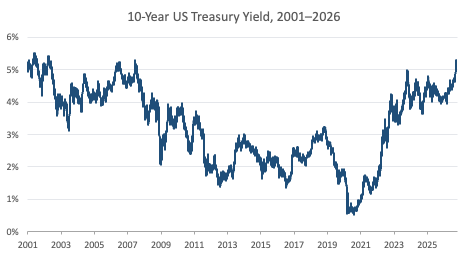
The chart below tracks the yield on the 10-year U.S. Treasury note. Yield is the annualized return an investor can expect if they buy the bond at its current price and hold it to maturity, subject to the usual assumptions. About six years ago, 10-year yields were near 0.5%; by October 9, 2026, they had risen above 5%. That rise has been painful for existing bondholders: as yields climb, bond prices fall. A newly issued 10-year bond priced near 0.5% would lose roughly a third of its market value if its yield rose to 5%. That’s an illustration of the price move; an investor’s actual return depends on the specific bond, when they bought it and how long they held it.
Source: Sagard Wealth
Higher yields are not automatically a problem. The key question is whether the economy is growing fast enough to keep the government’s debt burden manageable. When the economy grows faster than the average interest rate on government debt, it can help stabilize debt relative to GDP, though deficits and other fiscal choices matter too. When borrowing costs stay above growth, the debt burden can become harder to manage.
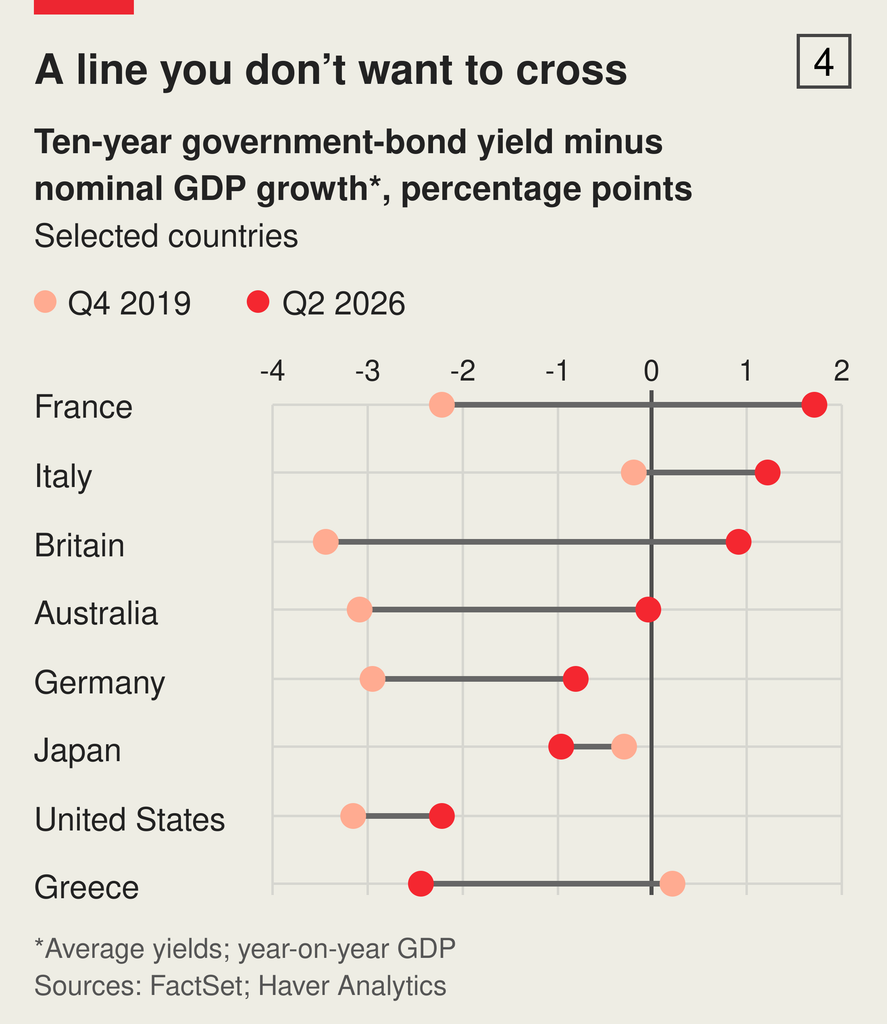
The Economist chart below compares nominal GDP growth with 10-year government bond yields across several major economies. The U.S. picture is still more comfortable: growth has generally exceeded borrowing costs, supporting an improvement in its debt dynamics over the past seven years. Europe’s picture is more strained, especially in France, Italy and Britain, where the gap has narrowed or turned less favourable. In France and Britain, the shift has become part of a broader political debate about taxes, spending and fiscal discipline. Bond investors are not the only ones weighing in, but they do have a way of making their views felt.
A Fabulous Debt
I recently read “A Fabulous Debt” written by Financial Times journalist Robin Wigglesworth (a name that sounds straight out of Ted Lasso). It’s a great book framing the importance of the bond market and there are some great examples of where the bond market flexes its muscles. Below are three examples, two of which are focused on France and Britain.
A Tail of Two Cities (or at least finances)
Britain’s bond market helped it keep fighting a long, expensive war against Revolutionary and Napoleonic France. The government borrowed from investors by issuing debt, much of it in the form of Consols: perpetual bonds that paid interest but had no fixed repayment date. Banks, merchants and other investors could buy and trade them, giving the government access to a broad pool of capital. In effect, the Brits were able to borrow unlimited amounts of money at 3%, whereas the French market was more Bifurcated, with much higher interest rates.
The borrowed money paid for Britain’s navy and military, and helped fund subsidies and loans to its European allies. The bond market didn’t defeat Napoleon by itself. It helped Britain sustain the war and support coalitions over many years. The cost was a very large national debt, which Britain carried into the postwar period.
The broader lesson: a government with credible access to investors can turn future tax revenue into resources for a crisis today.
The Liz Truss Moment
In September 2022, British Prime Minister Liz Truss and Chancellor Kwasi Kwarteng announced a package of large tax cuts and other measures, including energy support, with much of the cost expected to be financed through borrowing. The plan arrived without an accompanying forecast from the independent Office for Budget Responsibility, leaving investors uncertain about its impact on government debt and inflation.
Bond investors quickly demanded higher yields to lend to the UK government. Gilt (UK government bonds) prices fell, the pound weakened, and the sharp move in long-term yields put pressure on pension funds that used leveraged strategies to match their future obligations. As those funds faced demands for cash collateral, some were forced to sell gilts, pushing prices down further.
The Bank of England stepped in with temporary gilt purchases to restore orderly trading and give pension funds time to shore up their finances. The government then reversed much of the plan, and Truss resigned after just 45 days as prime minister.
The episode showed how quickly bond investors can raise a government’s borrowing costs when they lose confidence in its fiscal plans.
Prickly Rose Lawn
On April 2, 2025, President Trump announced sweeping “reciprocal” tariffs. Investors worried about the effects on growth, inflation and government borrowing. In a striking break from the usual flight to safety, Treasury prices fell as stocks sold off, pushing the 10-year yield from below 4% to about 4.5%. Higher yields meant higher borrowing costs for the government.
On April 9, Trump paused most of the higher country-specific tariffs for 90 days, leaving a 10% baseline in place while raising tariffs on China. Trump later acknowledged watching the bond market and said investors had become “a little queasy.” Administration officials also pointed to trade negotiations, so the precise weight the market turmoil had in the decision was disputed.
The bond market’s message was that investors would not automatically absorb more U.S. debt on the government’s terms: confidence matters, and a loss of it can raise financing costs quickly.
Listen to the King
The bond market doesn’t get to pick the government, but it can make life uncomfortable for whoever is in charge. Britain used it to fund a war against Napoleon; Liz Truss learned how quickly investors can reject a fiscal plan; and in 2025, U.S. Treasury yields helped remind Washington that tariffs and borrowing costs can collide. The King rarely needs to make a speech. A few moves in the yield curve can get the message across.
For investors, a rise in yields isn’t automatically a royal decree of doom. It’s a signal to understand: are markets reacting to stronger growth, persistent inflation, heavy borrowing or weakening confidence? The answer matters more than the headline number. Governments can debate with voters, but they ignore bond investors at their peril. The King may be upset, but he usually tells us something worth hearing.